The Video Games That Defined Every Generation
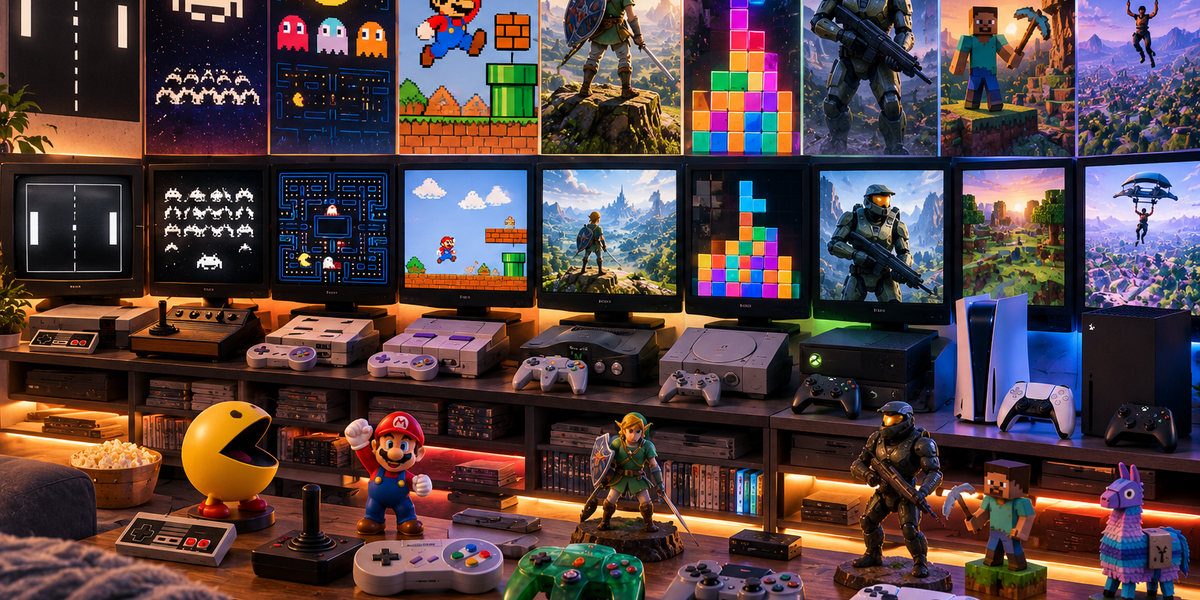
Every generation has a video game that immediately brings back a particular time and place. For one generation, it might be the electronic sounds of an arcade filled with Pac-Man machines. For another, it is sitting on the floor in front of a television playing Super Mario Bros. Someone else remembers trading Pokémon at school, staying up late playing Halo with friends, building a first shelter in Minecraft, or dropping onto an island in Fortnite.
Video games have changed dramatically since their earliest days. What began as simple shapes moving across a screen has grown into one of the world’s largest entertainment industries, producing enormous virtual worlds, competitive esports, cinematic stories, social spaces, and games played by hundreds of millions of people.
But the history of gaming is not simply a story of improving graphics. The most important games changed expectations. They introduced new ways to play, established genres, transformed technology, created cultural moments, or reached audiences that previously did not consider themselves gamers.
These are the games that helped define each major era.
Pong Made Video Games Feel Like the Future
It is difficult to imagine anything simpler than Pong today. Two vertical paddles move up and down while a small square bounces between them.
Yet when Pong appeared in the early 1970s, that simplicity felt revolutionary.
People could control something happening on a television-like screen and compete against another person in real time. The concept was easy enough to understand almost instantly, which made it ideal for introducing the public to interactive electronic entertainment.
Pong became one of the earliest major commercial successes in video gaming and helped demonstrate that games could become a genuine entertainment business.
It did not have a story, characters, expansive environments, or sophisticated graphics. It barely needed instructions.
What it had was interaction.
That single idea was powerful enough to help launch an industry.
Space Invaders Turned Gaming Into an Obsession
By the late 1970s, arcade games were becoming more sophisticated, and Space Invaders helped transform them into a cultural phenomenon.
Players controlled a small weapon at the bottom of the screen while rows of alien invaders moved steadily toward them.
The concept created escalating tension. As enemies disappeared, the remaining invaders moved faster, making each round increasingly frantic.
Space Invaders also popularized the pursuit of high scores. Gaming became something people could practice, improve at, and compete over even when they were technically playing alone.
Arcades became social spaces where players watched one another, compared scores, and fed coins into machines for another attempt.
Video games were no longer simply technological curiosities. They were becoming habits.
Pac-Man Gave Video Games a Personality
Early arcade games often focused on spaceships, shooting, or abstract sports. Pac-Man felt different.
The bright yellow character had a recognizable identity. The ghosts had distinctive appearances and behaviors. The maze was immediately understandable, and the game appealed to audiences beyond the young men who had dominated many early arcades.
Pac-Man became a genuine pop-culture character.
Merchandise, cartoons, music, and advertising followed. For perhaps the first time, a video game character became recognizable even to people who did not regularly play games.
The game also demonstrated that successful video games did not need realistic violence or complex controls.
A character running through a maze eating dots could become one of the most recognizable images in entertainment.
Super Mario Bros. Helped Rescue Home Gaming
The early 1980s were turbulent for the American video game industry. A flood of poor-quality products and other market problems contributed to a major crash.
Then Nintendo’s home console and Super Mario Bros. helped change the direction of the industry.
Released in the mid-1980s, Super Mario Bros. showed what carefully designed home gaming could look like.
Mario ran and jumped through colorful scrolling environments filled with secrets, enemies, pipes, power-ups, and increasingly challenging obstacles.
The controls were simple, but the design taught players through experience. The first level remains famous partly because it introduces many of the game’s fundamental ideas without requiring lengthy explanations.
Super Mario Bros. helped establish Nintendo as a dominant force and turned Mario into one of the most recognizable fictional characters in the world.
For an entire generation, turning on a game console meant entering the Mushroom Kingdom.
The Legend of Zelda Made Exploration the Point
While Super Mario Bros. pushed players forward through carefully constructed levels, The Legend of Zelda encouraged them to explore.
Players entered a mysterious world without being told exactly where to go. They discovered caves, collected equipment, solved puzzles, fought enemies, and gradually learned how different parts of the world connected.
That sense of discovery became enormously influential.
Zelda helped establish ideas that would later appear across adventure games, action RPGs, and open-world titles.
It also helped normalize the idea that progress in a video game could be preserved rather than requiring players to complete everything in one sitting.
Games were becoming larger experiences that players might explore over days or weeks.
Tetris Proved That Great Games Did Not Need Spectacular Graphics
Tetris is one of gaming’s greatest examples of simplicity producing extraordinary depth.
Different geometric pieces fall from the top of the screen. Players rotate and arrange them to complete horizontal lines.
That is essentially the entire idea.
Yet the combination of spatial reasoning, increasing speed, and constant decision-making makes the game endlessly replayable.
Tetris became particularly important when it was bundled with Nintendo’s Game Boy. Suddenly, gaming could travel almost anywhere.
Children played it, but so did parents and adults who might never have purchased a traditional video game.
Tetris demonstrated something the industry occasionally forgets: technological complexity and great game design are not the same thing.
A nearly perfect gameplay loop can survive generations of hardware.
Sonic the Hedgehog Turned Gaming Into a Console Rivalry
By the early 1990s, Nintendo had a serious competitor.
Sega’s Sonic the Hedgehog was designed around speed, attitude, and a distinctly different personality from Mario.
Sonic raced through colorful levels at speeds that made the game feel technologically impressive and culturally different from Nintendo’s offerings.
The rivalry between Sega and Nintendo became one of gaming’s defining battles.
Players did not simply own different consoles. They chose sides.
Playground debates over Mario versus Sonic became an early version of the intense brand loyalties that would later surround PlayStation, Xbox, Nintendo, PC gaming, and even individual game franchises.
Gaming was developing tribes.
Street Fighter II Made Competitive Gaming Social
Fighting games existed before Street Fighter II, but Capcom’s arcade hit helped define the genre.
Players selected characters with different fighting styles and competed directly against one another.
The game rewarded timing, practice, strategy, and knowledge of special moves. A skilled player could dominate an arcade machine while challengers lined up for their turn.
This created a competitive culture that extended far beyond simply completing a game.
Street Fighter II helped establish traditions that would eventually develop into modern fighting-game tournaments and esports communities.
The person standing beside you was no longer just another player.
They were the opponent.
Doom Changed What Computer Games Could Feel Like
When Doom arrived in 1993, it felt astonishingly fast and immersive.
The player moved through dangerous environments from a first-person perspective, fighting enemies and searching for exits, weapons, and secrets.
Doom was not the first first-person shooter, but its influence on the genre was enormous.
Its technology, speed, level design, multiplayer features, and shareware distribution helped it spread rapidly among PC users.
For years afterward, new first-person shooters were sometimes casually described as “Doom clones.”
The game also became part of broader cultural debates about violence in video games, debates that would continue for decades.
Most importantly, Doom demonstrated how powerful the first-person perspective could be.
The screen was no longer showing a character you controlled from a distance.
It felt like you were inside the world.
Pokémon Became More Than a Game
Pokémon began as a pair of Game Boy games, but it quickly became something much larger.
Players explored a world, captured creatures, trained them, battled with them, and tried to complete their collections.
The crucial innovation was that no player could easily do everything alone.
Different versions contained different Pokémon, encouraging players to trade with friends. The Game Boy’s link cable turned collecting into a social activity.
Then came trading cards, television shows, films, toys, and an enormous merchandising ecosystem.
For children growing up in the late 1990s and early 2000s, Pokémon was not simply something they played.
It was a shared language.
You knew the characters, discussed teams, traded cards, argued over favorites, and carried the experience between the digital and physical worlds.
Few gaming franchises have ever embedded themselves so deeply into childhood culture.
Super Mario 64 Changed How We Moved Through Games
The transition from two-dimensional games to three-dimensional worlds created enormous design challenges.
Super Mario 64 provided one of the clearest answers.
Instead of moving primarily left and right, players could run freely through 3D environments, control the camera, explore spaces from different angles, and approach objectives in less linear ways.
The analog stick on the Nintendo 64 controller allowed movement with a level of precision that felt dramatically different from traditional directional buttons.
Many ideas that now seem completely normal in 3D games had to be invented, tested, or refined during this period.
Super Mario 64 became one of the most influential examples of how 3D movement could work.
Final Fantasy VII Made Games Feel Cinematic
Role-playing games had passionate audiences long before Final Fantasy VII, but its arrival on the original PlayStation helped introduce the genre to a much larger international audience.
Its combination of pre-rendered environments, 3D characters, dramatic music, cinematic sequences, and an ambitious story made the game feel enormous.
For many players, it demonstrated that video games could deliver emotionally memorable stories on a scale comparable to other entertainment media.
The PlayStation era also marked an important technological transition from cartridges toward optical discs, which could hold much more data.
That additional capacity helped developers create games with larger worlds, extensive music, voice recordings, and elaborate cinematic sequences.
Gaming was beginning to look increasingly like an entertainment medium capable of telling genuinely ambitious stories.
The Sims Turned Ordinary Life Into a Game
Most games gave players extraordinary missions. The Sims asked them to build a house, find a job, make friends, cook dinner, and remember to use the bathroom.
Somehow, it became fascinating.
The Sims allowed players to create people and then manage their relationships, careers, homes, needs, and daily lives.
There was no single correct way to play.
Some players carefully built successful families. Others designed elaborate houses. Some deliberately created chaos just to see what would happen.
The game’s open-ended structure attracted people who had little interest in traditional action games.
It helped demonstrate that games did not need enemies, scores, or conventional victory conditions to be compelling.
Sometimes watching a tiny digital person burn dinner was enough.
Grand Theft Auto III Made Open Worlds Feel Alive
Open environments existed before Grand Theft Auto III, but its version of Liberty City changed expectations.
Players could follow missions or simply explore the city, steal vehicles, discover side activities, listen to fictional radio stations, and create their own chaos.
The world felt less like a sequence of levels and more like a place.
That freedom became enormously influential.
Open-world design would eventually become one of the dominant structures in major video games, appearing in everything from fantasy adventures to superhero games.
Grand Theft Auto III also intensified debates over mature content in gaming.
Video games were no longer being treated purely as children’s entertainment. The medium was growing up alongside the people who had played earlier generations.
Halo Made the Xbox Matter
When Microsoft entered the console business with the original Xbox, it needed a game that could convince people the machine deserved to exist.
Halo: Combat Evolved became that game.
Its science-fiction world, enemy design, vehicles, weapons, controls, and multiplayer made it one of the defining console shooters of its generation.
Halo also helped establish first-person shooters as a natural fit for console controllers, a genre that had previously been strongly associated with PC gaming.
Its sequels would become particularly important for online console multiplayer.
For many players, Halo was not just a game they completed.
It was where friends gathered.
World of Warcraft Turned a Game Into a Place
World of Warcraft demonstrated the enormous social potential of online worlds.
Millions of players entered the same persistent fantasy universe, creating characters, completing quests, exploring regions, fighting monsters, joining guilds, trading items, and forming relationships.
The game did not simply exist while you were playing.
Its world continued without you.
That created a very different relationship between players and games. People organized their schedules around raids, formed long-term friendships, developed guild politics, and spent thousands of hours building characters.
World of Warcraft became one of the clearest demonstrations that online games could function as social spaces rather than simply entertainment products.
Wii Sports Made Everyone a Gamer
Nintendo took a major risk with the Wii.
Instead of competing directly with rivals through raw processing power, the company introduced motion controls designed to make games more physically intuitive.
Wii Sports was the perfect demonstration.
Swing the controller like a tennis racket and the character swings. Move it like a bowling motion and the ball travels down the lane.
People who had never learned complicated game controllers could understand the concept immediately.
Families played together. Grandparents played with grandchildren. Wii consoles appeared in living rooms, retirement homes, parties, and rehabilitation settings.
For a period, the definition of a “gamer” expanded dramatically.
Call of Duty Turned Online Multiplayer Into a Daily Habit
The Call of Duty series, particularly during its enormously successful modern military era, helped transform online multiplayer into one of the dominant forms of console gaming.
Players returned night after night for competitive matches, unlocked weapons and upgrades, increased their ranks, and played with friends through voice chat.
The experience was designed around repetition and progression.
You did not necessarily “finish” multiplayer in the traditional sense. You kept returning.
That structure would become increasingly important across the industry.
Games were evolving from products that players completed into services and communities designed to remain part of their lives for months or years.
Minecraft Gave Players the Tools Instead of the Instructions
Minecraft looks almost primitive beside many visually sophisticated games.
Its world is made of blocks. Characters are simple. Textures are deliberately basic.
Yet those limitations became its greatest strength.
Players could gather resources, survive dangerous nights, explore enormous procedurally generated worlds, construct buildings, create machines, or simply experiment.
There was no requirement to play one particular way.
Children built castles. Engineers constructed functioning logic systems. Friends created shared servers. Teachers used it in classrooms. Creators produced videos watched by millions.
Minecraft became something closer to digital Lego than a conventional game.
Instead of asking, “Can you beat this challenge?” it often asked, “What do you want to make?”
That question helped turn it into one of the most influential games ever created.
Skyrim Made Getting Lost Part of the Experience
The Elder Scrolls V: Skyrim arrived with a vast fantasy world filled with mountains, caves, cities, ruins, quests, factions, and countless distractions.
Players might begin walking toward one objective and discover something completely different along the way.
That became part of the appeal.
Skyrim embodied a particular style of open-world gaming where exploration itself could be more memorable than completing the central storyline.
Its enormous modding community also extended the game’s life far beyond its original release.
For many players, Skyrim became less like a story they completed and more like a world they periodically returned to.
Dark Souls Changed How Players Thought About Difficulty
For years, mainstream game design increasingly emphasized accessibility and guidance.
Dark Souls moved in another direction.
It was demanding, mysterious, and often unwilling to explain itself clearly. Enemies could punish careless decisions, death had meaningful consequences, and progress required observation and patience.
Yet the difficulty rarely existed purely for frustration. Success felt meaningful precisely because failure had been possible.
Dark Souls influenced an entire generation of game design and helped establish what became known as the “Soulslike” genre.
It reminded the industry that players sometimes enjoy being challenged rather than constantly protected from failure.
Candy Crush Showed the Power of Mobile Gaming
Smartphones changed who could play games and when they could play them.
Candy Crush Saga became one of the clearest symbols of that shift.
Its basic mechanics were easy to understand, sessions could be short, and the game was available on a device people already carried everywhere.
Mobile gaming did not require buying a console or gaming computer.
That dramatically expanded the potential audience.
It also accelerated controversial business models built around free downloads, in-app purchases, waiting mechanics, and digital currencies.
The economic structure of gaming was changing alongside the technology.
Pokémon Go Took Gaming Into the Real World
Pokémon Go created one of the strangest gaming moments of the 2010s.
Suddenly, parks, streets, landmarks, and public squares were filled with people staring at their phones while searching for virtual creatures.
The game combined smartphone location technology, maps, cameras, and the Pokémon franchise to create an experience tied to physical movement.
Players had to go outside.
For several months after its launch, the game became a global social phenomenon.
It demonstrated how smartphones could connect digital games with physical locations in ways traditional consoles could not.
Fortnite Became a Social Space
Fortnite began as a game, but its cultural impact came from becoming something larger.
Its battle royale mode brought large groups of players into the same match, where they competed until one player or team remained.
The game was free to play, available across multiple platforms, frequently updated, and deeply connected to internet culture.
Its dances appeared in schools and sports celebrations. Musicians held virtual events inside the game. Major entertainment franchises appeared through collaborations.
For younger players especially, Fortnite became somewhere to spend time with friends.
The distinction between game, social network, entertainment platform, and virtual event space became increasingly blurry.
Among Us Proved Graphics Were Still Not Everything
Among Us became enormously popular years after its original release, helped by streamers, online communities, and the unusual social conditions of 2020.
Its graphics were simple and its rules easy to understand.
Players worked together on a spaceship while secretly trying to determine which participants were impostors.
The real game happened in conversation.
Who was lying? Who could be trusted? Why was someone behaving suspiciously?
Among Us demonstrated once again that sophisticated graphics are not necessary for cultural impact.
Sometimes the most powerful game mechanic is simply giving people an excuse to talk, accuse, bluff, and laugh together.
Elden Ring Brought a Demanding Genre to a Massive Audience
Elden Ring took many ideas associated with the Dark Souls games and placed them inside a vast open world.
Players could encounter extremely difficult enemies, explore mysterious environments, discover hidden areas, and approach challenges in different ways.
Its success showed that demanding games did not need to remain a niche category.
Players were willing to tolerate uncertainty and repeated failure when exploration, discovery, and eventual success felt rewarding.
The game also reflected a broader shift in modern gaming: audiences had become comfortable with enormous worlds that trusted them to find their own direction.
The Games That Define Generations Do More Than Sell Copies
The most influential video games are not always simply the ones with the highest sales.
They change behavior.
Pong showed that electronic interaction could be entertainment. Space Invaders and Pac-Man made arcades cultural spaces. Super Mario Bros. helped establish the modern home console. Zelda made exploration central to game design. Tetris demonstrated the power of simplicity and portability.
Pokémon turned gaming into a social ecosystem. Super Mario 64 helped define movement in three-dimensional worlds. Grand Theft Auto III changed expectations for open environments. Halo helped normalize console shooters and online multiplayer. World of Warcraft transformed games into persistent communities.
The Wii expanded the audience. Minecraft turned players into creators. Mobile games put gaming into billions of pockets. Fortnite blurred the line between playing and socializing.
Each generation inherited ideas created by the one before it.
Every Generation Thinks Its Games Were the Best
Ask someone who grew up with an NES about Super Mario Bros. and you will probably get a very different emotional response than you would from someone discovering it today.
The same is true of Pokémon, Halo, World of Warcraft, Minecraft, Fortnite, and countless other games.
Part of what makes a game “generation-defining” has nothing to do with graphics or technical sophistication.
It is timing.
It is the game you played after school. The one everyone talked about the next morning. The one you discovered with friends before you knew every secret could be found online. The game associated with a particular console, bedroom, summer holiday, sibling, or group of friends.
Technology changes, but that part of gaming does not.
Every generation gets its own worlds to disappear into.
The graphics become more realistic, the maps become larger, the internet connects more players, and the hardware becomes more powerful. Yet the games people remember most are rarely remembered because of polygon counts or processor speeds.
They are remembered because, for a particular group of people at a particular moment, everyone wanted to play.