
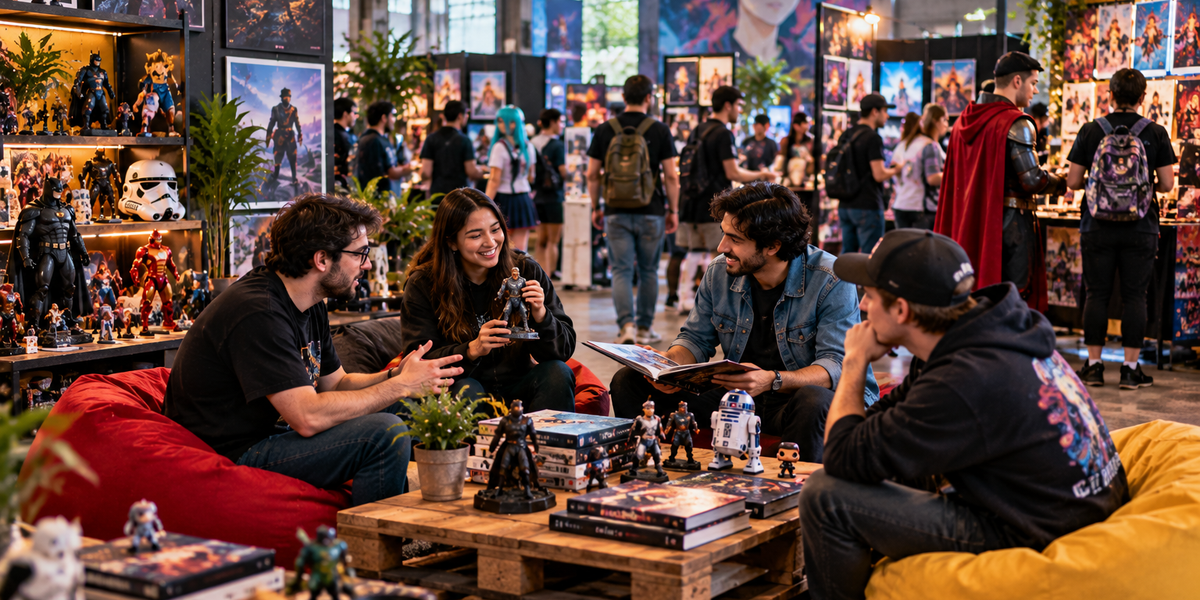
The Strange World of Internet Subcultures
Spend enough time online and eventually you will discover a community devoted to something you had no idea people cared about so intensely. There are communities dedicated to restoring old computers, identifying mysterious objects, building mechanical keyboards, collecting abandoned websites, solving fictional mysteries, modifying video games, studying obscure transportation systems, rating everyday objects, creating elaborate fictional universes, and documenting technology that disappeared decades ago.
Some internet subcultures contain millions of people. Others may have only a few hundred dedicated members scattered across the world. Many develop their own vocabulary, humor, celebrities, arguments, traditions, aesthetics, and unwritten rules. To outsiders, these communities can appear completely incomprehensible. To the people inside them, they can feel like home.
Internet subcultures are not entirely new. Humans have always formed communities around shared interests, identities, beliefs, hobbies, and obsessions. What the internet changed was geography. A person no longer needs enough nearby people to share an unusual interest. If only one person in every hundred thousand cares deeply about something, the internet can still bring thousands of them together.
That simple change created one of the strangest features of modern culture: almost every interest can now become its own world.
The Internet Did Not Invent Subcultures
Subcultures existed long before anyone logged onto the internet.
Punk scenes, science-fiction fandoms, skateboarding communities, underground music movements, tabletop gaming groups, amateur radio clubs, hacker communities, and countless other groups developed their own identities without social media.
People found one another through physical spaces, magazines, newsletters, conventions, clubs, record stores, universities, and word of mouth.
These communities often required effort to enter.
You had to know where people gathered. You might need to attend an event, subscribe to a publication, visit a particular store, or know someone already involved.
The internet removed much of that friction.
A search can now transport someone into a community within seconds.
Early Internet Communities Felt Like Separate Places
Before today’s enormous social platforms dominated online life, internet communities often existed on separate websites.
Forums, bulletin boards, chat rooms, mailing lists, and personal websites created distinct digital environments.
Each community developed its own personality.
A computer-hardware forum could feel completely different from a science-fiction discussion board. Members recognized usernames, remembered old arguments, developed recurring jokes, and created informal social hierarchies.
People did not simply consume content.
They inhabited communities.
This gave early internet culture a strange sense of geography. Websites felt like places you visited rather than content flowing through one endless feed.
Forums Created Tiny Digital Societies
Traditional forums were particularly good at producing subcultures because conversations remained organized around communities rather than individual personalities.
Someone might join a forum about cars and gradually learn which members were experts, which arguments appeared every month, which jokes required years of context, and which opinions were guaranteed to start a fight.
New users had to learn the culture.
Some communities even had elaborate initiation rituals without officially calling them that. A beginner might ask a question that experienced members had answered hundreds of times and immediately reveal that they had not read the community’s guides.
Over time, regular members accumulated reputation.
A forum could become a small society with historians, experts, comedians, troublemakers, moderators, and legends.
Reddit Turned Subcultures Into an Organizational System
Large platforms eventually discovered that people naturally organize themselves around interests.
Reddit made this especially explicit by dividing the platform into communities dedicated to different subjects.
The concept scales almost infinitely.
A broad community can discuss movies while another discusses horror movies, another analyzes one particular franchise, and another exists solely to make jokes about a single character.
The deeper you travel, the more specialized things become.
This structure demonstrates one of the internet’s fundamental laws: if enough people are interested in a subject, someone will eventually create a community for it.
If the community becomes large enough, smaller communities will then form because people believe the original community has become too mainstream.
The cycle can continue indefinitely.
Every Subculture Eventually Develops Its Own Language
One of the easiest ways to recognize an internet subculture is through vocabulary.
Communities invent abbreviations, slang, technical terms, jokes, and references that make perfect sense internally but sound bizarre to outsiders.
Gaming communities are particularly good examples.
Different games develop terminology describing strategies, character roles, movement techniques, rankings, equipment, and player behavior.
Technology communities do the same thing.
Mechanical-keyboard enthusiasts discuss switches, layouts, keycaps, actuation, stabilizers, and sound profiles with a level of detail that can surprise someone who thought a keyboard was simply a keyboard.
Specialized language makes communication faster for insiders.
It also creates a boundary.
Understanding the vocabulary becomes evidence that you belong.
Memes Function Like Cultural Passwords
Internet memes are often treated as disposable jokes, but within subcultures they serve a deeper function.
A meme can contain years of community history inside one image or phrase.
Someone unfamiliar with the context sees nonsense.
An insider understands immediately.
That makes memes a kind of cultural password.
Recognizing the reference demonstrates that you have spent enough time inside the community to understand its history.
Some jokes become so layered that explaining them destroys what makes them funny.
The humor comes partly from recognition.
This is why internet communities can feel surprisingly intimate even when thousands of strangers participate.
They share a language outsiders do not completely understand.
Fandoms Became Their Own Digital Nations
Entertainment fandoms are among the internet’s largest and most complicated subcultures.
Fans gather around films, television shows, books, games, musicians, fictional characters, and celebrities.
Once a fandom becomes large enough, it develops internal institutions.
There are fan artists, theory creators, meme accounts, archivists, reviewers, fan-fiction writers, collectors, moderators, and people who seem capable of remembering every detail ever established about the fictional universe.
Fandoms also develop political disputes of their own.
People argue about characters, adaptations, relationships, endings, casting decisions, and what should count as official canon.
From the outside, these disagreements can look absurdly serious.
From inside the community, they can involve years of emotional investment.
Fan Fiction Created Parallel Universes
Fan fiction is one of the internet’s most interesting examples of participatory culture.
Instead of simply consuming a story, fans create new stories using existing characters and fictional worlds.
Some expand events that happened off-screen. Others imagine alternate endings, relationships, settings, or completely different universes.
The scale of this activity is enormous.
A popular fictional universe can inspire thousands upon thousands of independent stories.
This changes the relationship between audiences and entertainment.
The official creator may control what counts as canon, but fans can create an almost infinite number of alternative possibilities.
The fictional universe becomes something the audience actively plays with.
Shipping Developed an Entire Vocabulary
Within fandoms, few activities demonstrate subcultural complexity better than “shipping,” where fans become invested in particular fictional relationships.
Entire communities can form around preferred pairings.
They develop names, artwork, theories, stories, and interpretations supporting those relationships.
Competing groups sometimes argue with extraordinary intensity.
To someone outside the fandom, the disagreement may appear to concern two fictional characters who do not exist.
Inside the fandom, however, those characters can represent emotional themes, identities, interpretations, and years of community history.
This is a recurring feature of internet subcultures.
The object of interest may look trivial from outside while carrying enormous meaning inside.
Gaming Communities Contain Thousands of Smaller Cultures
Calling “gaming” one internet subculture barely makes sense anymore.
Gaming contains countless subcultures.
Competitive players may care about rankings and optimization. Speedrunners study games like engineering problems. Modders alter games and build new content. Retro collectors preserve old hardware. Lore communities analyze fictional history. Challenge runners intentionally make games harder.
Even one game can contain several communities that barely interact.
A casual player and a professional competitor may technically play the same title while experiencing completely different cultures around it.
The internet allows these specialized communities to become increasingly deep.
A hobby does not merely have fans anymore.
It has subcultures within subcultures within subcultures.
Speedrunning Turned Games Into Scientific Experiments
Speedrunning is one of the best examples of the internet creating an entirely new way of interacting with existing media.
Players attempt to complete games as quickly as possible under specific rules.
That sounds simple until you see the level of analysis involved.
Communities study movement mechanics, loading behavior, glitches, random-number generation, hardware differences, and obscure pieces of game code.
A single second can matter.
Routes are developed collectively and improved over years.
Someone discovers a strange glitch. Another person determines how to reproduce it. Someone else discovers where it saves time. Eventually, elite runners practice the technique thousands of times.
The original game becomes almost secondary.
The community has created a new game inside it.
Modding Communities Refuse to Accept Games as Finished
Video-game modding communities take another approach.
Instead of treating a released game as complete, modders modify it.
They create new characters, environments, graphics, interfaces, quests, mechanics, and sometimes entirely new games using an existing game’s technology.
Older titles can remain alive for decades because communities continue rebuilding and expanding them.
Modding represents a particularly geeky philosophy of technology: if something does not work exactly how you want, change it.
The same philosophy appears in countless other internet communities.
People customize computers, software, keyboards, operating systems, cars, electronics, and household devices.
Customization becomes part of identity.
Mechanical Keyboards Became an Unexpected Obsession
To most people, a keyboard is something that comes with a computer.
To mechanical-keyboard enthusiasts, that description is almost offensive in its simplicity.
The community obsesses over switches, springs, keycap materials, layouts, cases, mounting systems, lubrication, stabilizers, acoustics, and typing feel.
People build keyboards costing far more than ordinary consumer models.
They record videos focused almost entirely on how keyboards sound.
They debate tiny differences in components that most users would never notice.
This may seem absurd until you recognize the pattern.
Every mature subculture takes something ordinary and discovers extraordinary depth inside it.
That depth is part of the attraction.
Custom PC Culture Turned Computers Into Personal Expression
Building a personal computer once primarily meant choosing components based on performance.
Internet communities turned the process into something closer to automotive customization.
Builders now obsess over cases, cooling systems, cable management, lighting, desk setups, monitors, keyboards, and visual themes.
A computer can become both a machine and a display piece.
People share photographs of their setups and receive feedback from communities that can immediately identify every component.
The desk itself becomes part of the hobby.
This demonstrates how internet culture can transform practical objects into aesthetic identities.
The goal is no longer merely to own a functional computer.
It is to build one that feels specifically yours.
Retro Computing Preserves Technology Everyone Else Forgot
While mainstream technology culture constantly focuses on what comes next, retro-computing communities look backward.
Enthusiasts restore old computers, operating systems, game consoles, software, and peripherals.
Machines that most people discarded decades ago become collectible objects.
Part of the appeal is nostalgia.
Another part is preservation.
Digital technology ages strangely. A book printed a century ago can still be opened and read. Software created thirty years ago may depend on hardware, storage formats, operating systems, and services that no longer exist.
Retro-computing communities preserve knowledge that might otherwise disappear.
What looks like collecting obsolete machines can become a form of technological archaeology.
Lost Media Communities Search for Things That Disappeared
The internet is often imagined as a place where everything lasts forever.
Lost-media communities know that this is not true.
Television episodes, websites, games, advertisements, songs, software, films, and online videos can disappear.
Sometimes only fragments remain.
Communities dedicated to lost media attempt to locate and preserve these missing pieces of culture.
The search can become surprisingly elaborate.
Members investigate old television schedules, contact former creators, search archives, compare screenshots, track down physical recordings, and reconstruct histories from tiny clues.
Finding an obscure children’s television episode from decades ago can become a genuine internet event.
The value is not always in the media itself.
The mystery becomes part of the experience.
Internet Mysteries Create Amateur Detective Communities
People online love unsolved puzzles.
A mysterious photograph, unidentified song, strange website, unexplained video, or unknown object can attract thousands of amateur investigators.
Participants analyze metadata, architecture, accents, weather, clothing, road signs, shadows, historical records, and anything else that might provide a clue.
Most mysteries eventually turn out to have ordinary explanations.
That rarely reduces the excitement.
The appeal comes from collective investigation.
Thousands of people with different expertise can attack the same problem from different directions.
The internet effectively creates a temporary distributed detective agency.
ARGs Deliberately Blur Fiction and Reality
Alternate reality games, usually called ARGs, take internet mystery culture and deliberately turn it into entertainment.
Creators hide fictional narratives across websites, videos, social-media accounts, codes, phone numbers, images, and real-world clues.
Participants must discover that the game exists before they can even begin solving it.
A strange video may contain a hidden message. That message may lead to a website. The website may contain coordinates. Those coordinates may reveal another piece of the story.
The format turns the internet itself into the game board.
The best ARGs create a feeling that fiction has leaked into reality.
Horror Found a Natural Home Online
Internet culture developed its own forms of horror.
Creepypasta stories spread through forums and websites, often presented with enough ambiguity to make readers wonder where fiction ended.
Characters and stories could evolve as communities repeated, modified, illustrated, and expanded them.
Later forms of online horror used fake broadcasts, corrupted videos, abandoned websites, surveillance footage, and deliberately outdated technology to create unsettling fictional worlds.
The internet is particularly suited to this kind of storytelling because users are accustomed to encountering unexplained content without context.
A strange video discovered at 2 a.m. can feel very different from a horror movie deliberately selected from a streaming service.
Aesthetics Became Communities of Their Own
Some internet subcultures are organized less around activities than feelings.
Online aesthetics combine music, fashion, architecture, photography, colors, technology, and nostalgia into recognizable visual identities.
Communities form around imagined versions of the past, idealized futures, abandoned shopping centers, early computer graphics, cozy libraries, neon cities, rural landscapes, or countless other visual themes.
These aesthetics often receive names, which allows people to search for them and build communities around them.
The naming itself is powerful.
Once a vague feeling has a searchable label, thousands of people can discover that other people feel it too.
Liminal Spaces Turned Empty Buildings Into a Genre
One particularly strange online aesthetic focuses on liminal spaces.
These are environments such as empty hotel corridors, abandoned shopping centers, quiet airports, school hallways at night, or office buildings without people.
The locations are ordinary, but their emptiness makes them unsettling.
Online communities began collecting images that produced this feeling.
Eventually, the aesthetic developed its own vocabulary, fictional mythology, and related horror projects.
An empty room became a genre.
This is the internet’s subculture machine operating at full power: identify a strangely specific feeling, give it a name, collect examples, create lore around it, and suddenly a community exists.
Online Communities Can Turn Consumption Into Expertise
One reason subcultures become so deep is that the internet allows endless comparison.
Someone interested in coffee does not simply drink coffee anymore.
They can learn about grinders, water chemistry, extraction temperatures, processing methods, roast profiles, brewing ratios, and specific farms.
Someone interested in headphones can study frequency-response graphs and amplifier specifications.
Someone interested in flashlights can compare emitters, batteries, beam patterns, and color-rendering indexes.
Every ordinary product contains a rabbit hole.
Internet communities are exceptionally good at finding it.
Algorithms Accelerated Subculture Formation
Recommendation algorithms changed how people discover niche interests.
Previously, entering a subculture often required actively searching for it.
Now the subculture can find you.
Watch a few videos about restoring an old computer and suddenly the platform recommends electronics repair, retro gaming, vintage keyboards, and computer-history channels.
The algorithm notices patterns in attention and gradually moves users toward increasingly specialized content.
This can be wonderful when it helps people discover hobbies and communities they genuinely enjoy.
It can also create increasingly narrow information environments.
The same mechanism that helps someone discover a harmless hobby can reinforce more troubling communities and beliefs.
Subcultures Can Become Echo Chambers
Strong communities create belonging, but belonging has disadvantages when disagreement becomes unwelcome.
If members primarily communicate with people who share similar assumptions, those assumptions can begin feeling universally obvious.
Outsiders appear uninformed or hostile.
Internal beliefs become increasingly difficult to challenge.
This dynamic can occur in fandoms, political communities, investment groups, wellness spaces, technology communities, and almost any other online environment.
The problem is not simply that people form groups.
Humans have always done that.
The difference is that online platforms can connect people continuously while algorithms prioritize content likely to keep them engaged.
Irony Makes Internet Subcultures Difficult to Read
Online communities often communicate through layers of irony.
Someone may express an opinion as a joke, repeat the joke so frequently that it becomes part of their identity, and eventually adopt the opinion sincerely.
This makes internet culture difficult for outsiders to interpret.
Is the community serious?
Is everyone pretending?
Is the joke itself the community?
Sometimes the answer is all three.
Internet language evolves quickly because users constantly remix meanings.
Words can shift from sincere to ironic and back again within surprisingly short periods.
Understanding the community requires understanding not only what people say but the context surrounding how they say it.
Subcultures Create Micro-Celebrities
Every sufficiently large internet community develops people who are famous inside it and almost completely unknown outside it.
A person may have enormous influence within a particular game, hobby, forum, or technical community while remaining anonymous to the general public.
This creates a strange new form of celebrity.
Someone can walk through an airport unnoticed while thousands of people online immediately recognize their username.
Influence becomes fragmented.
Instead of one mass culture containing a limited number of famous people, the internet supports thousands of overlapping cultures with their own experts and personalities.
Communities Develop Their Own Historical Events
Stay in an internet community long enough and it develops history.
There was the famous argument.
The disastrous update.
The legendary post.
The user everyone remembers.
The meme that disappeared.
The controversy nobody wants to discuss again.
New members encounter references to these events without understanding them, much like someone entering a country and slowly learning its cultural history.
This gives digital communities continuity.
They are not simply groups of people discussing the same subject.
They accumulate shared memories.
Online Identity Can Be More Specific Than Offline Identity
Offline social life often requires people to present broad versions of themselves.
At work, someone is a colleague. At school, a student. Within a family, a relative.
Online, the same person can participate in several highly specialized identities.
They might be a competitive gamer in one community, a photography enthusiast in another, a fan-fiction writer somewhere else, and a mechanical-keyboard expert on another platform.
None of those identities needs to dominate the person’s entire life.
The internet allows identity to become modular.
People can enter the exact community where one small part of themselves makes perfect sense.
The Internet Makes Weird Interests Feel Normal
Perhaps the most positive feature of internet subcultures is their ability to reduce isolation.
Before the internet, someone with an extremely unusual hobby might genuinely believe nobody else cared about it.
Now they can often find a community within minutes.
That matters.
People can exchange knowledge, receive feedback, build friendships, collaborate on projects, and discover that their unusual enthusiasm is shared by thousands of others.
The internet did not make people strange.
It revealed how many different kinds of strange people already existed.
The Rabbit Hole Never Really Ends
Every internet subculture contains doors leading to another one.
Someone interested in gaming discovers speedrunning. Speedrunning leads to glitches. Glitches lead to reverse engineering. Reverse engineering leads to old hardware. Old hardware leads to retro computing. Retro computing leads to lost software. Lost software leads to digital preservation.
One curiosity produces another.
This is why spending time online can feel like exploring an endless library where every book contains a doorway into another library.
The internet’s greatest strength and greatest danger may be the same thing: there is always something else to discover.
Internet Culture Is Really Thousands of Cultures
People often talk about “internet culture” as though the internet were one enormous community.
It is not.
The internet is better understood as an environment containing countless overlapping cultures.
Some are enormous and temporary. Others remain small for decades. Some exist around serious intellectual interests, while others are built around jokes so specific that explaining them would take an hour.
People move between these cultures constantly, carrying language, memes, ideas, and behaviors from one community into another.
Occasionally, something escapes a small community and spreads everywhere.
A niche joke becomes a global meme. An obscure hobby becomes fashionable. A tiny creator becomes famous. A strange aesthetic influences mainstream design.
Then the internet moves on to something else.
There Is Probably a Community for Whatever You Are Into
The strangest thing about internet subcultures is how quickly they stop seeming strange once you understand them.
From outside, spending hundreds of hours researching old keyboards, fictional lore, abandoned websites, game glitches, or unidentified songs may look ridiculous.
From inside, there are histories to learn, problems to solve, people to meet, and discoveries to make.
That is the secret behind most subcultures.
The object of obsession matters less than the experience of caring about something alongside other people who care just as much.
The internet made it possible for almost any sufficiently specific interest to become a community.
And somewhere online right now, people are probably having an incredibly serious argument about something you did not know existed.