The Real Difference Between AI, Machine Learning, and Deep Learning
Artificial intelligence, machine learning, and deep learning are often used as though they mean exactly the same thing. A company launches an AI product, a news article describes a breakthrough in machine learning, and a researcher talks about deep learning, even though all three may be discussing closely related technology. The confusion is understandable because these concepts overlap, but they describe different levels of the same technological family.
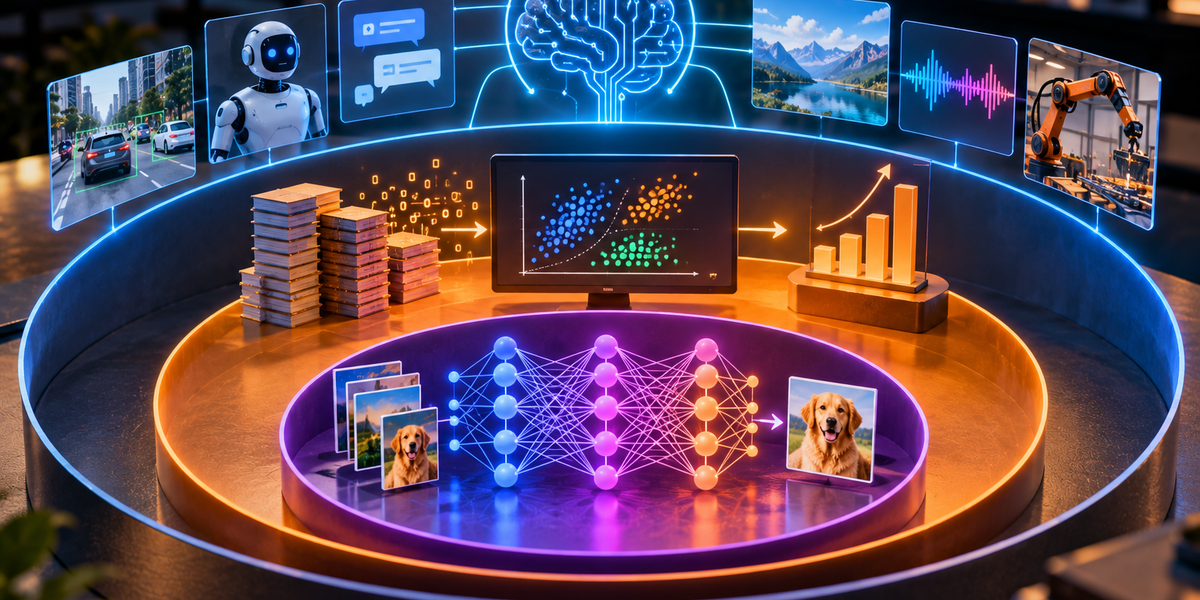
The easiest way to understand the relationship is to imagine three circles sitting inside one another. Artificial intelligence is the largest circle and describes the broad goal of creating computer systems capable of performing tasks that appear to require intelligence. Machine learning is a smaller circle inside AI and describes systems that learn patterns from data rather than relying entirely on manually written rules. Deep learning is an even smaller circle inside machine learning and uses large, layered neural networks to learn especially complicated patterns. In other words, deep learning is machine learning, and machine learning is part of artificial intelligence, but not every AI system uses machine learning and not every machine-learning system uses deep learning.
Understanding those differences makes modern technology much less mysterious because it reveals that “AI” is not one invention. It is a broad field containing many different approaches to making computers behave intelligently.
Artificial Intelligence Is the Biggest Category
Artificial intelligence is the broadest of the three terms. It refers generally to attempts to create machines capable of performing tasks that would normally require some form of human intelligence. Those tasks might include understanding language, recognizing objects, solving problems, planning actions, making decisions, playing games, or interpreting complicated information.
The important point is that an AI system does not necessarily need to learn. Earlier artificial intelligence often relied heavily on rules created manually by programmers. If a particular situation occurred, the computer followed a predefined response. Large collections of these rules could produce behavior that appeared intelligent even though the machine was not learning from experience in the modern machine-learning sense.
A chess program, for example, can be considered artificial intelligence because it evaluates positions and selects moves. Depending on how it is built, however, it does not necessarily need deep learning or even machine learning. Artificial intelligence describes the objective of intelligent behavior rather than one specific technical method used to achieve it.
Early AI Was Often Built From Rules
Imagine trying to create a computer system that recommends what someone should wear based on the weather. A programmer could manually create a set of instructions saying that if the temperature is below a certain level, recommend a coat, while higher temperatures might produce a recommendation for lighter clothing. Additional rules could account for rain, snow, wind, or sunshine.
Such a system can make decisions that appear intelligent, but it does not necessarily learn anything. If the programmer never creates a rule for an unexpected combination of weather conditions, the system may struggle to respond appropriately. Improving it requires humans to identify new situations and write additional instructions.
This rule-based approach was central to many early AI systems. It works well when a problem can be described clearly with a manageable number of rules, but it becomes increasingly difficult when the real world contains millions of possible variations.
Machine Learning Changed the Approach
Machine learning introduced a fundamentally different strategy. Instead of trying to describe every rule manually, developers could provide examples and allow the computer to identify useful patterns.
Suppose you want a system to distinguish spam email from legitimate messages. A traditional rule-based system might search for particular phrases, excessive punctuation, suspicious links, or certain sender characteristics. The problem is that spammers constantly change their behavior, and legitimate emails can sometimes contain exactly the same features.
A machine-learning system can instead be trained using large numbers of emails that have already been classified. It analyzes patterns associated with spam and legitimate messages and gradually develops a model capable of making predictions about new emails it has never encountered before.
The programmer still designs the system and training process, but the final decision rules are learned from data rather than individually written by a human.
Machine Learning Is About Finding Patterns
At its core, machine learning is about using existing information to make useful predictions about new information. A bank might train a system using historical transactions so that it can identify payments that resemble fraud. A streaming platform might study viewing behavior to predict which film a user will enjoy. A retailer might analyze previous purchases to estimate which products someone is likely to buy.
The system does not need to understand these situations in exactly the way a person does. It needs to detect patterns that are useful for making accurate predictions. If customers who behave in a particular way frequently purchase a certain product, a machine-learning system may learn that relationship even if nobody explicitly programs that exact rule.
This ability to discover relationships in large datasets made machine learning enormously useful because many real-world problems contain too many variables for humans to define every rule manually.
Training Is How Machine Learning Improves
Machine-learning systems need examples from which to learn. The process of exposing a model to data and adjusting it based on its performance is called training. During training, the system attempts to identify relationships that allow it to produce accurate outputs when it encounters new information.
Imagine training a system to predict house prices. The training data might contain information about thousands of previously sold homes, including their locations, sizes, numbers of bedrooms, ages, and sale prices. The system analyzes relationships between these characteristics and the final prices, gradually developing a model that can estimate the value of a home it has never seen before.
The objective is not simply to memorize every property in the training data. A useful machine-learning model needs to generalize, meaning it should learn broader patterns that remain useful when presented with new examples.
Machine Learning Comes in Different Forms
Not all machine learning happens in the same way. One common approach is supervised learning, where the training data contains examples paired with correct answers. If a model is learning to identify dogs and cats, the training images may already be labeled so the system can compare its predictions with the correct categories.
Unsupervised learning works differently because the data does not necessarily contain predetermined labels. Instead, the system searches for patterns, structures, or groups within the information. A company might use this approach to identify clusters of customers with similar purchasing behavior without deciding those customer groups in advance.
Another important approach is reinforcement learning, where a system learns through actions and consequences. The system receives rewards for desirable outcomes and penalties or weaker rewards for undesirable ones, gradually learning strategies that produce better results. This approach has been particularly important in areas such as robotics and game-playing systems.
These approaches are all forms of machine learning, but none automatically requires deep learning.
Traditional Machine Learning Often Depends on Human-Chosen Features
Before deep learning became dominant in many areas, machine-learning projects frequently required humans to decide which characteristics of the data were most important. These characteristics are often called features.
Suppose developers want to build a system that recognizes handwritten numbers. They might design features describing edges, curves, intersections, or other visual properties. The machine-learning algorithm then uses those features to distinguish one number from another.
This can work extremely well, but it requires expertise. Humans need to understand the problem well enough to decide which characteristics are useful.
Deep learning changed this process by allowing models to learn many useful representations automatically from raw or relatively unprocessed data.
Deep Learning Is a Type of Machine Learning
Deep learning is a specialized form of machine learning built primarily around artificial neural networks containing multiple processing layers. These networks can learn extremely complicated patterns from enormous amounts of information.
The word “deep” refers to the presence of many layers within the network rather than describing how intellectually deep the system is. Information passes through these layers, where it is transformed repeatedly before producing an output.
This structure allows the network to develop increasingly sophisticated representations. In an image-recognition system, early processing might respond to simple edges and shapes, while later layers combine those patterns into more complex structures associated with eyes, faces, vehicles, animals, or other objects.
Instead of humans defining every useful visual feature manually, the network can learn many of them during training.
Neural Networks Are Inspired by Brains but Are Not Digital Brains
Artificial neural networks are loosely inspired by the way biological neurons connect and communicate, which explains the terminology. However, it would be misleading to imagine them as miniature artificial versions of human brains.
A neural network is fundamentally a mathematical computational structure. It contains interconnected units whose relationships can be adjusted during training. Those adjustable values allow the network to represent patterns within data.
When the model makes an incorrect prediction during training, its internal values can be adjusted slightly so that it becomes more likely to produce a better answer in the future. Repeating this process across enormous numbers of examples gradually produces useful behavior.
The similarities to biological brains are therefore conceptual rather than literal. Modern neural networks and human brains operate in profoundly different ways.
Why More Layers Can Be Powerful
The advantage of deep neural networks comes partly from their ability to build complicated representations from simpler ones. Instead of requiring humans to describe every important pattern, different layers can gradually transform raw information into increasingly useful internal representations.
Consider speech recognition. The original input may simply be an audio waveform. Early processing can identify basic acoustic patterns, while later processing connects those patterns with sounds, words, phrases, and broader linguistic context. The system learns these relationships through training rather than relying entirely on a programmer manually defining what every spoken word should look like as an audio signal.
This ability becomes particularly valuable when dealing with information such as images, audio, video, and natural language, where useful patterns can be extraordinarily complicated.
Why Deep Learning Became So Important
The basic ideas behind neural networks are not new, but several developments made deep learning dramatically more practical. Enormous amounts of digital data became available, computing hardware became much more powerful, and specialized processors such as graphics processing units proved extremely effective at performing the calculations required for neural networks.
Researchers also developed better training methods and network architectures. Together, these changes allowed neural networks to become much larger and more capable than earlier versions.
Deep learning began producing major improvements in image recognition, speech recognition, translation, language processing, recommendation systems, and many other areas. Eventually, it became one of the central technologies behind the modern AI boom.
A Simple Example Shows the Difference
Imagine that you want to build a system that recognizes photographs of dogs. A traditional rule-based AI approach might attempt to describe dogs through manually written instructions involving ears, fur, legs, tails, and other characteristics. The difficulty is that dogs appear in countless breeds, sizes, positions, environments, and lighting conditions.
A traditional machine-learning approach could improve on this by training a model using many examples while humans identify useful visual features for the system to analyze. The model learns how those features relate to the probability that an image contains a dog.
A deep-learning approach can receive enormous collections of images and use a multilayer neural network to learn many relevant visual representations automatically. It gradually becomes capable of recognizing patterns associated with dogs without humans explicitly describing every possible shape of ear, tail, or face.
All three approaches could reasonably be described as AI because all are attempting to perform an intelligent task. The difference lies in how they accomplish it.
Generative AI Usually Relies Heavily on Deep Learning
Generative AI systems create new content such as text, images, audio, video, and computer code. Many of the most powerful modern generative systems rely on deep neural networks trained on enormous datasets.
Large language models use deep-learning architectures to identify extremely complex patterns in language. Image generators learn relationships between visual information and concepts represented through text or other signals. Audio models can learn patterns associated with speech, music, and environmental sound.
The result is a system capable of producing new combinations based on what it learned during training. This is why the recent explosion of generative AI is closely connected to advances in deep learning.
However, generative AI and deep learning are not synonyms. Deep learning can also be used for tasks that generate nothing, such as recognizing objects, detecting fraud, or classifying medical images.
Large Language Models Are Deep-Learning Systems
Modern large language models are one prominent example of deep learning. They contain large neural networks trained on enormous amounts of language-related information. During training, they learn patterns connecting words, phrases, concepts, grammatical structures, programming languages, writing styles, and many other forms of information represented through text and other data.
Many modern language models use an architecture known as the transformer, which is particularly effective at identifying relationships between different parts of a sequence. This allows the model to consider context when interpreting or generating language.
The model is still fundamentally performing prediction. Given the context it has received, it estimates which piece of information should come next. Repeating that prediction rapidly allows it to generate complete paragraphs, explanations, stories, computer code, and other outputs.
The sophistication comes from the extraordinary number of relationships the deep-learning system has learned.
Deep Learning Usually Needs More Data
Traditional machine-learning methods can sometimes work extremely well with relatively modest datasets, particularly when the problem is structured and experts understand which features matter.
Deep learning generally becomes especially powerful when large amounts of data are available.
A neural network containing millions or billions of adjustable parameters needs enough useful information to learn meaningful patterns. Without sufficient training data, a very large model can fail to generalize effectively.
This is one reason modern AI development has become closely connected to enormous datasets. The availability and quality of information can be just as important as the architecture of the model itself.
More data is not automatically better, however. Poor-quality, duplicated, inaccurate, or biased information can introduce problems regardless of its quantity.
Deep Learning Also Requires More Computing Power
Deep neural networks can require enormous amounts of computation during training. Each training example passes through many layers, and the system repeatedly adjusts huge numbers of internal parameters.
Specialized hardware such as GPUs and other AI accelerators makes this process practical by performing many calculations simultaneously.
Large AI models may be trained using clusters containing thousands of processors working together. Training can continue for weeks or months, depending on the system.
Traditional machine-learning models can often be trained with dramatically fewer computing resources.
This difference helps explain why the largest deep-learning systems are often developed by companies and research organizations with access to substantial computing infrastructure.
More Complexity Does Not Automatically Mean Better
It is tempting to assume that deep learning is always superior because it is newer and more sophisticated.
That is not true.
For many problems, traditional machine-learning techniques are faster, cheaper, easier to interpret, and completely sufficient. A company predicting a relatively simple business outcome from structured spreadsheet data may not need an enormous neural network.
Using deep learning for every problem would be like using a construction crane to move a dining chair. The crane is more powerful, but that does not make it the appropriate tool.
Good AI engineering involves choosing the simplest method capable of solving the problem reliably.
Traditional Machine Learning Can Be Easier to Explain
Another advantage of some traditional machine-learning techniques is interpretability. Developers may be able to understand relatively clearly which features influenced a prediction.
Deep neural networks can be much more difficult to interpret because information is distributed across enormous numbers of parameters and layers.
Researchers can analyze these systems and develop methods for understanding their behavior, but explaining exactly why a large neural network produced one particular output can remain difficult.
This matters when AI is used in high-stakes environments. A bank, hospital, regulator, or court may care not only about whether a prediction is accurate but also about why the system produced it.
The most powerful model is not automatically the most appropriate one.
All Three Terms Describe Different Levels of the Same Story
The relationship between artificial intelligence, machine learning, and deep learning becomes much easier to remember when viewed as a hierarchy. Artificial intelligence is the broad ambition of making machines perform tasks associated with intelligence. Machine learning is one major way of achieving that goal by allowing systems to learn patterns from data. Deep learning is a particular machine-learning approach that uses multilayer neural networks to learn especially complex representations.
This means every deep-learning system used for an intelligent task can be described as machine learning and AI. A machine-learning system can be AI without using deep learning, while an AI system can theoretically operate without machine learning at all.
The categories overlap because they describe different levels of abstraction rather than competing technologies.
Where Generative AI Fits Into the Picture
Generative AI adds another term that can make the landscape seem even more confusing. It describes AI systems designed to generate new content rather than only classify, rank, or predict existing information.
A language model generating an article is generative AI. An image model creating an illustration is generative AI. A system composing music or producing synthetic video can also belong to this category.
Most advanced generative AI today relies heavily on deep learning, which means it also belongs to machine learning and therefore to the broader field of AI.
Generative AI describes what the system does. Deep learning describes an important part of how many such systems are built.
Those are different questions.
Not Every AI System Needs to Look Human
Popular culture often portrays artificial intelligence as a talking robot or digital mind, but most AI systems look nothing like that. They operate quietly inside ordinary technology.
A credit card company can use machine learning to detect suspicious transactions. A factory can use computer vision to identify defective products. A streaming platform can use recommendation algorithms to predict what someone wants to watch. A phone camera can use deep learning to recognize faces and improve photographs.
None of these systems needs to hold a conversation.
AI is better understood as a set of computational capabilities than as one specific type of machine.
The chatbot is simply one highly visible form.
Why Companies Call Almost Everything “AI”
The popularity of artificial intelligence has created a marketing problem. The term “AI” attracts attention, so companies sometimes apply it very broadly.
A feature that might once have been described as automation, predictive analytics, recommendation software, or machine learning may now simply be marketed as AI.
Technically, that description may sometimes be reasonable because AI is such a broad category. But it can also hide enormous differences in sophistication.
A simple rules engine and a massive generative model can both appear under the AI label even though the technology behind them is completely different.
Whenever a company says something “uses AI,” the more useful question is what the system actually does and how it does it.
The Difference Matters Because the Limitations Are Different
Understanding these categories is useful because different technologies fail in different ways. A manually programmed system can fail when it encounters a situation its rules never anticipated. A machine-learning model can fail when new data differs substantially from the examples it learned from. A deep-learning model can produce extremely sophisticated outputs while remaining difficult to interpret.
Generative models introduce another challenge because they can produce information that sounds convincing even when it is incorrect.
Calling all of these systems simply “AI” can hide those distinctions.
Knowing roughly what technology is underneath a product helps you understand what kinds of strengths and weaknesses to expect.
The Simplest Way to Remember It
If all the terminology becomes confusing, remember the three concepts from largest to smallest. Artificial intelligence is the overall field concerned with making computers perform tasks that seem intelligent. Machine learning is a major branch of AI in which computers learn patterns from examples rather than relying entirely on manually programmed rules. Deep learning is a branch of machine learning that uses multilayer neural networks to learn particularly complicated patterns from large amounts of information.
You can picture AI as a large umbrella. Machine learning sits underneath it, and deep learning sits underneath machine learning. Modern technologies such as large language models and sophisticated image generators rely heavily on that deepest layer, which is why deep learning receives so much attention today.
The terminology may sound complicated, but the underlying progression is surprisingly straightforward. First, humans tried to make computers behave intelligently by writing rules. Then they developed systems that could learn useful patterns from data. Finally, increasingly large neural networks became capable of learning patterns so complicated that machines could recognize images, understand speech, generate language, create pictures, and perform tasks that once seemed far beyond the reach of software.
AI is the big idea. Machine learning is one of the most important ways we pursue it. Deep learning is the technology that pushed many of those capabilities to an entirely new level.