The Difference Between AAA, Indie, and AA Games
Video games are often described using labels that sound more like financial ratings than entertainment categories. A huge new release might be called a AAA game. A small experimental title might be described as indie. Somewhere between them, you increasingly hear another term: AA.
These labels can be useful, but they are also surprisingly messy.
There is no universal authority that officially examines a game and certifies it as AAA, AA, or indie. The boundaries can shift depending on who is using the terms, and games increasingly appear that do not fit neatly into any category.
Still, the labels describe real differences in how games are created. They can tell you something about the size of the development team, the amount of money involved, the publisher behind the project, the scale of its marketing campaign, the technical ambitions of the game, and how much financial risk is attached to its success.
The simplest explanation is that AAA games are generally the industry’s biggest and most expensive productions, indie games are created with greater independence and usually smaller resources, and AA games occupy the increasingly interesting territory somewhere in between.
What Does AAA Actually Mean?
AAA, usually pronounced “triple-A,” refers broadly to the highest-budget tier of mainstream video game development.
Think of it as gaming’s equivalent of a major Hollywood blockbuster.
AAA games are typically produced or funded by large publishers and can involve hundreds or even thousands of people when external studios, contractors, localization teams, quality assurance staff, marketing teams, and other contributors are included.
These projects can take several years to complete.
They often feature highly detailed graphics, extensive voice acting, cinematic sequences, sophisticated animation, large environments, orchestral music, online infrastructure, and enormous amounts of content.
Just as importantly, they usually receive major marketing campaigns.
The goal is often not merely to create a successful game. It is to create one of the major entertainment releases of the year.
AAA Is Mostly About Scale, Not Quality
One of the biggest misconceptions is that AAA means “excellent.”
It does not.
AAA primarily describes the scale and commercial structure surrounding a game rather than guaranteeing its quality.
A AAA game can receive outstanding reviews and become a classic. Another can launch with technical problems, repetitive gameplay, or disappointing design despite costing an enormous amount to produce.
Likewise, a small independent game can be considerably more enjoyable or influential than a project with hundreds of millions of dollars behind it.
The label tells you approximately what kind of production you are dealing with.
It does not tell you whether the game is good.
Why AAA Games Cost So Much
Modern high-end game development is extraordinarily labor-intensive.
Consider a large open-world game containing several cities or regions.
Artists need to create buildings, landscapes, vehicles, clothing, weapons, vegetation, furniture, weather effects, and thousands of environmental objects. Animators need to make characters move convincingly. Writers create dialogue and stories. Actors record voices and sometimes perform motion capture. Engineers build gameplay systems, networking infrastructure, physics, artificial intelligence, and tools.
Then there are sound designers, composers, level designers, interface designers, producers, testers, localization teams, accessibility specialists, and countless other contributors.
A major project can remain in development for five years or longer while employing large teams.
The salaries alone can create an enormous budget before marketing even begins.
Marketing Can Be Almost as Important as Development
Creating an expensive game is only part of the AAA model.
Publishers also need millions of people to know that the game exists.
Trailers appear at major events. Advertisements run across websites and social media. Influencers and journalists receive previews. Billboards appear in major cities. Collector’s editions are produced. Promotional partnerships may connect the game with hardware companies, food brands, films, or other entertainment properties.
All of this costs money.
A major publisher may therefore have an enormous amount financially dependent on one release.
That helps explain why AAA development can sometimes become conservative.
When a company has invested an extraordinary amount of money into a game, experimentation becomes financially frightening.
Why AAA Games Often Belong to Existing Franchises
If you have ever wondered why the industry produces so many sequels, remakes, reboots, and established franchises, economics provides much of the answer.
Imagine spending hundreds of millions of dollars on a completely unknown game.
Nobody knows the characters. Nobody recognizes the name. The publisher has no guarantee that consumers will care.
Now imagine investing in another installment of a franchise with tens of millions of existing fans.
The second option may appear considerably safer.
This does not mean AAA developers lack creativity. Many enormous games are remarkably ambitious.
But the larger the financial investment becomes, the more pressure there is to reduce uncertainty.
Familiar franchises, genres, mechanics, and business models can make investors and publishers more comfortable.
What Is an Indie Game?
“Indie” comes from “independent.”
Traditionally, an indie game is created by an independent developer operating outside the financial and organizational structure of a major publisher.
The classic image is a tiny team, perhaps even one person, creating a game with limited money but considerable creative freedom.
That image is sometimes accurate.
Some famous indie games have indeed been created by individuals or very small teams.
However, modern indie development covers an enormous range. An independent studio might consist of two people working from home or dozens of experienced developers operating a professional company.
Some indie games now have substantial budgets and sophisticated production values.
Independence, rather than simply size, is the central idea.
Indie Does Not Mean Amateur
Another common misconception is that indie games are somehow less professional than AAA games.
That is increasingly difficult to defend.
Independent studios can contain developers who previously spent years working at major game companies. Modern game engines provide sophisticated technology that small teams could never have built themselves in earlier decades.
Digital distribution has also removed many barriers.
A developer no longer necessarily needs to manufacture physical discs, negotiate retail shelf space, or operate a global distribution network to reach players.
A small team can release a game digitally to an international audience.
The result is that indie games can now compete for attention alongside projects created with dramatically larger budgets.
Indie Developers Can Take Bigger Creative Risks
One of the greatest strengths of independent development is freedom.
A small team does not necessarily need to sell ten million copies to justify its existence.
That changes the mathematics of creativity.
An unusual game designed for a relatively specific audience might be financially viable if its development costs are modest.
A AAA publisher spending an enormous amount of money may need a much larger audience.
This is why indie games frequently experiment with unusual visual styles, storytelling techniques, mechanics, themes, and genres.
Ideas that would be difficult to justify inside a massive corporate production can become the entire foundation of an independent game.
Smaller budgets create limitations, but they can also create freedom.
Indie Games Often Turn Limitations Into Style
Independent developers usually cannot compete directly with AAA studios on raw production scale.
A team of five people cannot realistically create the same volume of photorealistic art as a project involving hundreds of artists.
So successful indie developers often compete differently.
They choose distinctive art styles rather than chasing realism. They focus on a small number of mechanics and polish them carefully. They use procedural generation to create variety. They tell stories through text instead of thousands of hours of recorded dialogue.
Constraints can force developers to make stronger creative decisions.
Instead of asking, “How do we create everything?” they ask, “What actually matters to this game?”
The answer can produce something more memorable than a technically larger project.
Minecraft Shows How Strange the Indie Label Can Become
Minecraft began as an independent project with extremely modest visual presentation.
Its block-based graphics looked simple beside the major releases of its era.
But its central idea was extraordinarily powerful: give players a world they could explore, reshape, and build within.
The game grew into a global phenomenon and eventually became part of one of the largest technology companies in the world.
At that point, describing Minecraft simply as an “indie game” became complicated.
Its origins were unquestionably independent, but its later scale was enormous.
This illustrates one of the problems with gaming labels. They can describe how a project began without accurately describing what it eventually becomes.
What Is a AA Game?
AA, pronounced “double-A,” generally describes games occupying the space between small independent productions and enormous AAA blockbusters.
These games may have professional studios, experienced developers, publisher support, substantial budgets, and high production values.
But their teams and financial expectations are usually smaller than those associated with the industry’s largest projects.
A AA game might focus on a 15-hour experience rather than a 100-hour open world. It might use high-quality graphics without attempting to create the most technically advanced visuals on the market.
It may concentrate resources on a few areas instead of trying to compete in every category.
That middle ground can be extremely valuable.
AA Games Used to Be Much More Common
Earlier generations of gaming contained many mid-budget releases.
Not every game needed to become a massive global event.
Publishers could produce smaller licensed games, experimental action titles, unusual RPGs, shorter adventures, and niche projects without investing blockbuster-level budgets.
As development costs increased, much of the traditional middle of the industry became squeezed.
Major publishers increasingly concentrated resources on large franchises capable of generating enormous returns, while digital distribution allowed smaller indie studios to flourish at the opposite end.
The result was sometimes described as a disappearing middle.
In recent years, however, interest in mid-budget games has grown again.
Players have shown that there is still demand for polished games that do not require the scale of the largest AAA productions.
Why AA Games Can Be a Sweet Spot
AA development can combine advantages from both ends of the industry.
These studios may have enough money to hire experienced developers, create strong visuals, record professional voice acting, and build polished gameplay systems.
At the same time, they may not face the same financial pressure as a project costing hundreds of millions of dollars.
That can leave more room for experimentation.
A AA developer might be able to make a strange combat system, unusual story, or focused single-player experience without needing to design the game for the broadest possible global audience.
This middle ground can produce games that feel ambitious without becoming bloated.
Budget Changes What Developers Can Build
The differences between AAA, AA, and indie games become clearer when you think about resources.
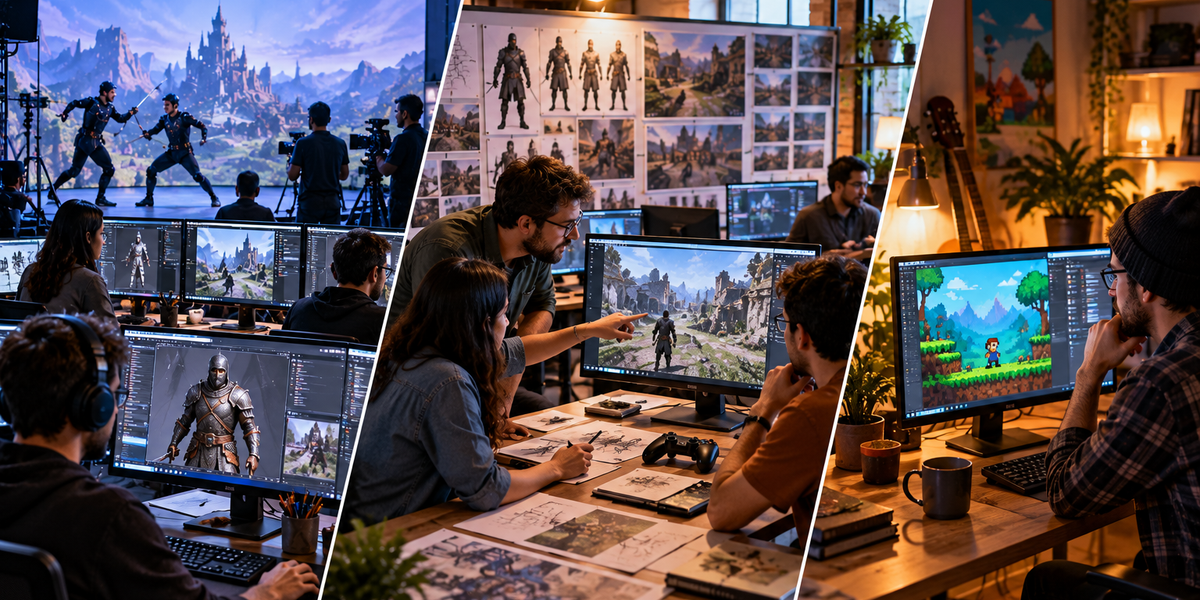
Suppose three studios want to create a medieval fantasy game.
The AAA studio might build an enormous open world containing multiple cities, hundreds of characters, fully voiced dialogue, advanced facial animation, complex weather systems, motion-captured combat, cinematic sequences, and years of post-launch content.
The AA studio might create a smaller world with fewer locations but still provide professional voice acting, polished combat, strong graphics, and a substantial story.
The indie studio might focus on one village, use stylized graphics, tell much of the story through text, and build the entire experience around one innovative mechanic.
None of those approaches is automatically superior.
They are different answers to the same fundamental question: how should limited development resources be spent?
Team Size Changes How Games Are Made
A tiny indie team can make decisions incredibly quickly.
The person designing the combat system may be sitting beside the person creating the art. In some cases, they are the same person.
Large AAA teams operate very differently.
Hundreds of people need coordination. Departments become specialized. One artist might spend months working on a very specific category of environmental assets. Producers manage schedules and dependencies between teams.
Large projects therefore require enormous organizational structures.
This creates advantages because specialists can produce extremely sophisticated work.
But it can also make rapid creative changes difficult.
Changing one major system late in development might affect hundreds of people.
Small teams are constrained by manpower. Large teams are constrained by complexity.
Graphics Are the Most Visible Difference
Production scale is often easiest to see in graphics.
AAA studios can afford enormous art departments producing highly detailed characters, realistic environments, advanced lighting, motion capture, and complex animations.
Indie games frequently use stylized graphics partly because photorealism is expensive.
But stylization is not necessarily a compromise.
Games such as Hollow Knight, Hades, Celeste, Stardew Valley, and countless others demonstrate how distinctive artistic direction can remain visually appealing long after technically impressive graphics have aged.
Realism requires constantly competing with the newest technology.
Strong art direction can be timeless.
Length Does Not Determine the Category
A 100-hour game is not automatically AAA, and a three-hour game is not automatically indie.
Independent developers can create enormous games, particularly through procedural generation or years of continued development.
AAA studios can create relatively short experiences with extremely high production values.
The labels describe the structure and scale of production more than the amount of time required to finish the game.
This distinction matters because players sometimes equate length with value.
A tightly designed ten-hour game may contain far more deliberate craftsmanship per hour than an enormous game filled with repetitive activities.
More content is not automatically better content.
Price Does Not Determine the Category Either
Indie games are often cheaper than AAA releases, but price alone does not define them.
An independent developer can charge a premium price if the market supports it. A AAA game can become inexpensive during a sale or appear inside a subscription service.
Free-to-play games complicate things further.
Some of the most expensive games ever operated are technically free to download.
The economics happen afterward through cosmetic purchases, battle passes, expansions, subscriptions, or other systems.
The amount a player pays upfront therefore tells you surprisingly little about how expensive the game was to make.
Publishing Makes the Indie Definition Complicated
Independent developers increasingly work with specialized publishers.
A publisher might provide funding, marketing, localization, quality assurance, console certification assistance, or distribution while allowing the studio to retain substantial creative control.
Does that mean the game is no longer indie?
There is no universally accepted answer.
Some people define indie primarily through ownership and creative independence. Others use the term more loosely to describe games with smaller teams and budgets.
As the independent ecosystem has become more professional, the line has become increasingly blurry.
A modern “indie” project can sometimes have a budget and team larger than what would have been considered a major production decades ago.
There Is Also Something Called AAAA
Occasionally, companies or commentators use the term AAAA, or “quadruple-A,” to describe exceptionally large and expensive games.
The term is mostly marketing language rather than a meaningful standardized category.
There is no agreed budget where a AAA game suddenly becomes AAAA.
The appearance of the term nevertheless reflects a real trend: the largest games have become extraordinarily expensive and complex to produce.
Some major projects involve multiple studios spread across different countries and remain in development for many years.
At a certain point, calling everything “AAA” stops communicating how dramatically production scale can vary even within the top tier.
Bigger Budgets Create Bigger Risks
Imagine an indie game costs $1 million to create while a blockbuster costs $200 million or more across development and marketing.
The smaller project needs far fewer sales to become financially successful.
The blockbuster may need millions of customers.
That creates pressure.
A massive game cannot simply be artistically interesting. It often needs to become a commercial event.
This can influence everything from design to monetization.
Publishers may favor familiar genres, broad accessibility, sequels, downloadable content, premium editions, or ongoing revenue systems because the financial stakes are so high.
The more expensive games become, the harder it can be to tolerate failure.
Small Games Can Afford to Be Weird
An indie developer might decide to create a game about managing paperwork at a border checkpoint, unpacking boxes after moving house, running a strange animal café, or exploring a story with almost no conventional combat.
Those ideas might sound difficult to pitch as $150 million projects.
At a smaller scale, they can make perfect sense.
This is one of the reasons independent games have become so important to the industry’s creative health.
They provide an environment where unusual ideas can be tested.
If those ideas succeed, larger studios often learn from them.
Innovation can therefore travel upward from indie development into mainstream games.
AAA Games Can Do Things Small Studios Simply Cannot
It would be equally misleading to pretend large budgets provide no creative benefits.
Some experiences require scale.
Creating an enormous city filled with detailed characters, recording thousands of lines of professional dialogue, building sophisticated performance-capture systems, or creating highly realistic environments can require resources unavailable to small teams.
AAA development can produce spectacle at a level few independent studios can match.
When enormous teams, strong creative direction, advanced technology, and huge budgets align successfully, the results can be extraordinary.
The problem is not that AAA games are too large.
It is that size alone cannot guarantee creativity or quality.
Indie Games Can Fail Too
Small budgets do not automatically produce artistic brilliance.
Thousands of independent games are released, and many disappear almost immediately.
Small teams face enormous challenges. Developers may lack funding, marketing expertise, technical resources, or enough time to polish their work.
Creative freedom can also produce unfocused design.
The successful indie games people remember represent only a portion of everything released.
Independence creates opportunities, not guarantees.
Just as AAA does not mean good, indie does not mean good either.
AA Games May Be Increasingly Important
As blockbuster development becomes more expensive, the AA model offers an appealing alternative.
Not every game needs a gigantic open world, hundreds of hours of content, photorealistic graphics, and a decade-long development cycle.
A studio can create something smaller, charge an appropriate price, reach a dedicated audience, and potentially build a sustainable business without needing to dominate the entire industry.
For players, this can mean more variety.
A healthy gaming industry probably needs projects at many different scales rather than forcing every successful studio to grow toward blockbuster production.
Sometimes the right size for a game is simply the size required to execute its idea well.
The Boundaries Are Becoming Harder to See
Modern game development increasingly resists simple categories.
An independent studio can create a visually stunning game using a commercial engine. A major publisher can fund a relatively small experimental title. A former AAA development team can establish an independent studio with substantial investment.
Early-access games can begin as tiny projects and grow into enormous productions.
Live-service games can receive years of investment after launch.
A game might therefore feel indie in its creative approach, AA in its production values, and AAA in its eventual popularity.
The labels remain useful shorthand, but they should not be treated as strict scientific classifications.
What the Labels Actually Tell You
AAA, AA, and indie are best understood as clues about how a game was made rather than predictions about how much you will enjoy it.
AAA usually means large teams, major financial investment, sophisticated production values, extensive marketing, and high commercial expectations.
AA generally describes the middle: professional production with meaningful resources but without the enormous scale of the industry’s biggest blockbusters.
Indie usually implies greater independence, smaller teams or budgets, and more freedom from the structures of major publishers, although the category has become increasingly broad.
Each model creates different opportunities and different limitations.
AAA developers have resources but enormous expectations. Indie developers have freedom but limited resources. AA developers attempt to balance ambition with manageable scale.
The interesting part is that none of those things determines whether a game will be memorable.
A game made by hundreds of people over seven years can become a masterpiece. So can a game created by one person working from a bedroom.
Players ultimately do not remember development budgets.
They remember whether they wanted to keep playing.