How Wireless Charging Actually Works
Place a smartphone on a charging pad and something slightly strange happens. There is no charging cable plugged into the phone, no exposed electrical connector between the charger and the battery, and yet within a second or two the familiar charging symbol appears on the screen.
Electricity seems to be jumping through empty space.
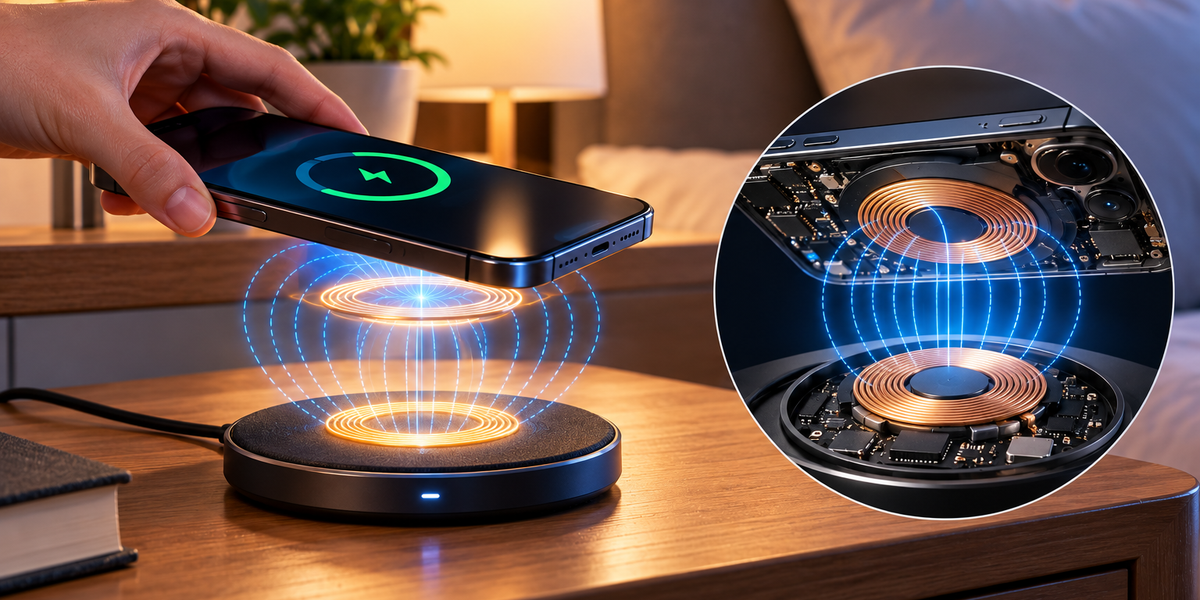
In a sense, it is, but not in the way people sometimes imagine. Wireless charging does not normally beam electricity across a room like a radio signal. Most wireless phone chargers transfer energy across a very short distance using magnetic fields. Inside both the charger and the phone are coils of wire, and those coils work together to transfer electrical energy without requiring a direct metal-to-metal connection.
The technology is based on electromagnetic induction, a principle of physics understood for nearly two centuries. What makes modern wireless charging impressive is not the basic discovery but how engineers have turned it into a compact, efficient, safe, and increasingly powerful system that fits inside devices only a few millimeters thick.
Wireless Charging Is Not Completely Wireless
The first thing to understand is that “wireless charging” is slightly misleading.
The charging pad itself usually needs a wire. It must receive electricity from a wall adapter, USB connection, vehicle, battery pack, or another power source.
The wireless part is the final step between the charging surface and the device.
Instead of electricity traveling through a cable plugged directly into the phone, electrical energy enters the charging pad and is converted into a changing magnetic field. The phone captures energy from that field and converts it back into electrical current that can charge its battery.
So wireless charging does not eliminate wires from the entire system. It eliminates the physical electrical connector between the charger and the device being charged.
The Basic Idea Comes From Electromagnetism
Electricity and magnetism are closely connected.
When electric current flows through a wire, it creates a magnetic field around that wire. If the wire is shaped into a coil, the magnetic effect can be concentrated.
Something equally important happens in the opposite direction. A changing magnetic field passing through a coil of wire can induce an electric voltage in that coil.
This relationship is known as electromagnetic induction.
Wireless chargers take advantage of both sides of this phenomenon. The charger uses electricity to create a changing magnetic field, while the phone uses that changing magnetic field to generate electricity.
Energy has effectively crossed the small gap between the two devices without requiring a traditional electrical plug.
There Are Two Coils Involved
A typical wireless charging system contains at least two important coils.
The first is the transmitter coil inside the charging pad or stand. The second is the receiver coil inside the phone or other device.
When you place the phone on the charger, electrical current flows through the transmitter coil. The charging system uses alternating current so the magnetic field is constantly changing.
That changing magnetic field reaches the receiver coil inside the phone.
Because the magnetic field through the receiver coil is changing, an electrical voltage is induced in the coil. The phone’s electronics capture that electrical energy and process it into a form suitable for charging the battery.
The two coils therefore behave somewhat like two sides of a transformer separated by a small air gap.
Why the Coils Need to Be Close Together
Wireless charging works best when the transmitter and receiver coils are physically close.
Magnetic coupling becomes weaker as the distance increases. The farther the phone moves from the charging surface, the less efficiently energy can be transferred.
This is why most wireless charging pads require you to place the phone directly on or very close to the charger.
A thick case can sometimes reduce charging performance because it increases the distance between the coils. Most ordinary cases are thin enough that wireless charging still works, but extremely thick cases or cases containing certain materials can interfere.
The short distance is not simply an arbitrary limitation imposed by manufacturers. It is a consequence of how this particular form of energy transfer works.
Alignment Matters
Distance is only part of the equation. The coils also need to be reasonably well aligned.
If the receiver coil in the phone sits directly above the transmitter coil in the charger, the magnetic coupling between them can be strong and efficient.
Move the phone too far sideways and the coils overlap less effectively. Charging may become slower or stop entirely.
Anyone who has used an older wireless charging pad has probably experienced this. You place the phone down, expect it to charge, and discover later that it was sitting slightly outside the correct position.
Modern charging systems have developed several ways to reduce this problem.
Why Magnets Improved Wireless Charging
Magnetic alignment systems can physically guide the device into the correct charging position.
Apple’s MagSafe system popularized this approach for smartphones by placing magnets around the wireless charging area. Compatible chargers snap into alignment with the receiving coil inside the phone.
The Qi2 wireless charging standard subsequently incorporated a magnetic alignment system called the Magnetic Power Profile.
The magnets are not usually the part transferring the charging energy. Their main job is positioning.
By holding the transmitter and receiver in better alignment, the system can improve reliability and reduce some of the energy losses caused by poor placement.
This is a good example of a relatively simple mechanical improvement making an electromagnetic technology considerably easier to use.
What Happens From the Wall to the Battery?
The complete charging process involves several conversions.
Electricity first enters the charging pad from its power source. Electronics inside the charger convert and control that electrical energy so alternating current flows through the transmitter coil.
The transmitter coil creates a changing magnetic field.
That magnetic field crosses the small gap between the charger and the phone and interacts with the receiver coil.
The receiver coil develops an alternating electrical voltage. Electronics inside the phone then convert and regulate that power into the form required by the charging system.
The phone’s power-management circuitry ultimately controls how electricity reaches the battery.
So the battery is not simply receiving raw electricity directly from a magnetic field. Several electronic systems carefully manage the process along the way.
The Battery Still Charges Normally
Wireless charging does not require a fundamentally different type of smartphone battery.
Modern phones generally use lithium-ion or related rechargeable battery technologies whether they are charged through a cable or wirelessly.
The difference lies primarily in how electrical power reaches the phone’s internal charging circuitry.
With wired charging, electricity travels through physical conductors in the charging cable and connector.
With wireless charging, energy crosses the final gap through electromagnetic induction before being converted back into electrical power.
Once the energy reaches the phone’s power-management system, the battery charging process follows the same general principles of carefully controlling voltage, current, temperature, and battery condition.
Why Wireless Charging Produces Heat
No real-world energy transfer system is perfectly efficient.
During wireless charging, some energy is lost rather than ending up stored in the battery. A significant portion of those losses eventually becomes heat.
The transmitter coil has electrical resistance. The receiver coil has resistance. Power-conversion electronics generate heat. Imperfect alignment can reduce efficiency further.
The phone itself also produces heat while its battery is charging.
This is why a phone may feel noticeably warm after sitting on a wireless charger.
Heat is particularly important for lithium-ion batteries because prolonged exposure to high temperatures can contribute to faster battery aging. Modern charging systems therefore monitor temperature and can reduce charging power when necessary.
Why Wired Charging Is Often More Efficient
A physical cable provides a relatively direct electrical connection between the power adapter and the device.
Wireless charging introduces additional conversion stages. Electricity must create a magnetic field, energy must cross the gap between coils, and that energy must then be converted back into usable electrical power.
Every conversion creates opportunities for energy loss.
For this reason, wireless charging is generally less energy-efficient than a comparable well-designed wired connection.
The difference for charging one phone may not feel dramatic to an individual user, but the underlying physics still matters.
Wireless charging trades some efficiency for convenience.
Why Wireless Charging Can Be Slower
Wireless charging speed depends on several factors, including the charger, phone, charging standard, power adapter, coil alignment, and temperature.
Higher charging power produces more heat, and heat needs to be carefully controlled. If the phone or charger becomes too warm, the system may reduce charging power to protect the battery and electronics.
Poor alignment can also reduce the amount of power transferred efficiently.
This means a charger advertised at a particular maximum wattage will not necessarily deliver that level continuously throughout the entire charging session.
The phone and charger constantly negotiate and adjust power based on conditions.
Modern wireless charging can be quite fast, but wired charging still has practical advantages when very high power and maximum efficiency are priorities.
The Phone and Charger Actually Communicate
Wireless charging is more sophisticated than simply creating a magnetic field and hoping a phone happens to be nearby.
Compatible devices can communicate with the charging system to coordinate power delivery.
The receiver can provide information that helps the transmitter determine how much power should be supplied. The system can adjust its behavior as charging conditions change.
This communication is important because different devices support different power levels.
A small pair of wireless earbuds does not need the same charging power as a smartphone. A charger should therefore not simply deliver maximum power indiscriminately.
The charging process is controlled dynamically rather than operating like an uncontrolled electromagnetic faucet.
How the Charger Knows Something Is on It
Wireless chargers need mechanisms for detecting compatible devices.
The charging system can monitor electrical characteristics of the transmitter coil and exchange information with a compatible receiver.
Once a valid device is detected, the charger can begin transferring appropriate power.
This also allows the system to stop or reduce power when the device is removed.
Without this kind of control, a wireless charger would waste energy and could create additional safety problems.
Modern wireless charging therefore combines basic electromagnetic physics with digital communication and power-management software.
What Happens If You Put Metal on a Wireless Charger?
Foreign metal objects can create problems because changing magnetic fields can induce electrical currents in conductive materials.
A coin, key, or other metal object placed in the charging area could potentially absorb energy and heat up.
Wireless charging standards therefore include mechanisms intended to detect foreign objects and reduce or stop power transfer when abnormal conditions are detected.
This is known as foreign object detection.
The exact behavior depends on the charger and device, which is one reason using properly certified charging equipment is important.
A wireless charger is not supposed to blindly transmit full power into anything placed on its surface.
Why Some Cases Interfere With Charging
Most thin plastic, silicone, or similar phone cases allow wireless charging to work normally because these materials do not significantly interfere with the magnetic coupling.
Problems can appear when cases are unusually thick or contain metal.
Metal plates are sometimes included in cases or attached to phones for magnetic car mounts. Depending on their location and design, these can interfere with wireless charging and potentially heat up.
Cards containing magnetic stripes or RFID-related technology can also be affected in some circumstances, which is why manufacturers may recommend removing certain wallet accessories before charging.
Magnetic alignment systems have made accessory design more predictable, but the materials placed between the two coils still matter.
Why Your Phone Stops Charging at Certain Temperatures
Smartphones continuously monitor battery and device temperature during charging.
If the phone becomes too hot, the charging system may reduce power or temporarily stop charging. The same can happen in extremely cold conditions.
This behavior can sometimes look like a faulty charger, particularly if the phone has been sitting in direct sunlight or performing a demanding task while charging.
In reality, the system may be deliberately protecting the battery.
Fast charging, wireless charging, gaming, navigation, video recording, and hot environmental conditions can all contribute to device temperature.
Modern phones therefore treat charging speed as something that can be adjusted dynamically rather than a fixed rate.
Does Wireless Charging Damage the Battery?
Wireless charging does not automatically destroy a phone battery.
Modern smartphones have battery-management systems designed to control charging and temperature. The phone does not simply continue forcing energy into the battery without supervision.
However, heat is one factor associated with battery degradation, and inefficient or poorly managed wireless charging can generate more heat than wired charging.
The practical impact depends on the charger, phone, charging power, alignment, environment, and charging habits.
For most users with properly designed equipment, wireless charging is a normal supported way of charging the device. Keeping the phone cool and using reputable compatible chargers matters more than treating wireless charging itself as inherently dangerous.
Why Charging Slows Near 100 Percent
Whether charging wirelessly or through a cable, smartphones generally do not charge at maximum power from zero all the way to 100 percent.
Lithium-ion batteries require careful charging management, particularly as they approach a high state of charge.
The charging system gradually reduces current as the battery becomes fuller. This protects the battery and prevents unsafe conditions.
Many phones also include optimized charging features that intentionally delay reaching 100 percent when the system predicts that the device will remain connected for a long period.
For example, a phone charging overnight might pause around a lower level and finish charging closer to the time it expects you to wake up.
The goal is not simply to charge as quickly as physically possible. It is to balance speed, safety, temperature, and long-term battery health.
Can Wireless Charging Work Through a Table?
In principle, inductive power can work across non-metallic materials, but distance is a major limitation.
Some furniture incorporates wireless charging transmitters directly beneath a thin surface so phones can charge when placed on a marked area.
However, simply putting an ordinary charging pad underneath a thick wooden table usually will not work effectively because the coils are too far apart.
Specialized systems can be designed for greater distances, but ordinary smartphone wireless charging is optimized for close coupling.
The technology works best when the two coils are separated by only a small gap.
Can Electricity Be Sent Wirelessly Across a Room?
Wireless power over longer distances is possible, but it involves different engineering challenges and tradeoffs.
Researchers and companies have explored technologies using resonant magnetic coupling, radio-frequency energy, lasers, and other methods to transfer power without cables.
The difficulty is delivering meaningful amounts of energy efficiently, safely, and predictably over distance.
Sending enough energy to charge a modern smartphone quickly across an entire room is very different from transmitting the tiny amounts of power needed by a low-energy sensor.
For now, mainstream wireless phone charging remains predominantly a close-range technology.
The phone usually needs to touch or nearly touch the charging surface.
Why Electric Toothbrushes Have Used Wireless Charging for Years
Smartphones made wireless charging highly visible, but inductive charging existed in consumer products long before it became common in phones.
Electric toothbrushes are a classic example.
Using exposed electrical charging contacts in a wet bathroom environment can create practical design problems. Inductive charging allows the toothbrush to receive power through sealed plastic surfaces without exposed charging connectors.
The charging base contains a transmitter coil, while the toothbrush contains a receiver system.
The same basic principle used to charge a modern smartphone can therefore be found in bathroom appliances that have existed for decades.
Wireless Charging Is Becoming More Standardized
Wireless charging becomes much more useful when devices and chargers follow common standards.
The Qi standard, developed by the Wireless Power Consortium, became the dominant wireless charging system for consumer electronics such as smartphones.
Standardization allows a compatible phone to work with chargers from different manufacturers rather than requiring a completely unique charging system for every device.
Qi2 builds on this ecosystem and includes magnetic alignment capabilities for compatible devices.
Standards also define communication, power delivery, safety behavior, and other requirements that help devices from different manufacturers work together.
This is what transforms wireless charging from an interesting technical trick into practical infrastructure.
The Physics Is Old, but the Engineering Is Modern
The most surprising thing about wireless charging is that the fundamental physics behind it is not new.
Michael Faraday demonstrated electromagnetic induction in the nineteenth century. The relationship between electricity and magnetism has therefore been understood for generations.
What has changed is our ability to control it precisely.
Modern semiconductor electronics can regulate power efficiently. Smartphones can communicate with chargers, monitor battery temperature, detect charging conditions, and adjust power in real time. Tiny coils can fit inside extremely thin devices, while standardized protocols allow equipment from different companies to communicate.
Wireless charging is therefore a modern application of very old physics.
What Actually Happens When You Put Your Phone Down
When you place your phone on a wireless charger, several things happen almost immediately.
The charger detects a compatible device and establishes communication. Electrical current flows through the transmitter coil, producing a changing magnetic field. That field passes through the receiver coil inside the phone and induces an electrical voltage.
The phone converts and regulates that energy, checks battery conditions and temperature, and directs an appropriate amount of electrical power toward the battery.
Throughout the process, the phone and charger can continue adjusting power based on alignment, temperature, battery level, and supported charging capabilities.
All of that happens while the phone appears to be doing nothing more than lying on a table.
Wireless Charging Is Really Magnetic Charging
The phrase “wireless charging” makes the technology sound almost futuristic, as though electricity is being broadcast invisibly through the air.
The reality is more precise and arguably more interesting.
Two coils sit extremely close together. Electricity flowing through one creates a changing magnetic field. That changing magnetic field induces electricity in the other. Electronics then transform and control that energy until it can safely charge the battery.
There is no invisible cable and no electrical contact between the phone and charger, but there is still a carefully controlled physical transfer of energy.
The next time you drop your phone onto a charging pad and see the battery icon immediately come alive, you are watching a principle discovered almost two centuries ago being managed by some of the most sophisticated electronics you own.
It looks effortless because all of the complicated physics has been hidden underneath the surface.