How the Internet Actually Works (Explained Simply)
The internet feels almost invisible. You open a browser, type a few words, tap a link, and a website appears. You send a message to someone thousands of miles away and they receive it almost instantly. You stream a movie without owning a physical copy, join a video call with people in different countries, or upload a photograph that can be viewed around the world seconds later. Because all of this happens so quickly, it is easy to imagine the internet as some enormous digital cloud floating somewhere above us. In reality, the internet is surprisingly physical.
At its simplest, the internet is a gigantic network of computers communicating with one another. Your phone, laptop, smart television, gaming console, and countless other devices connect to networks, which connect to larger networks, which eventually connect to computers around the world. Information moves between those machines according to a shared set of rules. Once you understand a few basic pieces—servers, IP addresses, routers, packets, DNS, and physical cables—the internet becomes much less mysterious.
The Internet Is a Network of Networks
There is no single machine called “the internet,” and there is no central building where everything online is stored. Instead, the internet is made up of millions of smaller networks connected together. Your home Wi-Fi network is one of them. Your workplace or university might operate another. Internet service providers run much larger networks, while telecommunications companies, governments, universities, cloud providers, and technology companies operate enormous networks of their own.
These networks agree on common technical standards that allow their computers to exchange information. That cooperation is what makes the internet possible. A computer connected to one network in Germany can communicate with a server connected to another network in the United States because both sides understand the same basic communication rules.
This is also where the word “internet” comes from. It essentially describes interconnected networks. Instead of creating one gigantic computer system controlled from a single location, the internet connects independent networks and allows information to travel between them.
What Happens When You Open a Website?
Suppose you type the address of a website into your browser and press Enter. Behind that simple action, several things happen extremely quickly.
Your computer first needs to figure out where the website actually lives. Websites are stored on computers called servers. A server is simply a computer designed to provide information or services to other computers. Some servers might host websites, while others handle email, store files, process payments, run applications, or perform countless other jobs.
Your browser needs to locate the appropriate server and ask it for the website. The server receives that request, processes it, and sends the necessary information back to your device. Your browser then interprets that information and turns it into the page you see on your screen.
All of this can happen in a fraction of a second, even when the server is physically located on another continent.
IP Addresses Are the Internet’s Addresses
Computers need a reliable way to identify one another. This is where IP addresses come in.
An Internet Protocol address, or IP address, works somewhat like a postal address for a device or network. It provides information that helps internet traffic reach the correct destination. Instead of writing someone’s street address on an envelope, computers use numerical addresses to determine where digital information needs to go.
You normally do not notice IP addresses because humans are much better at remembering names than strings of numbers and characters. It is easier to remember a website name than its underlying network address. The internet therefore uses another system to translate the names people use into the addresses computers need.
DNS Is Basically the Internet’s Phone Book
The Domain Name System, usually called DNS, connects human-friendly domain names with IP addresses. When you enter a website address into your browser, your device can ask a DNS service which IP address corresponds to that domain.
Imagine knowing someone’s name but not their phone number. You could look up the name in a directory and find the number you need. DNS performs a similar job for internet traffic. Your browser knows the website name, DNS helps identify the appropriate address, and your device can then begin communicating with the server associated with it.
Modern DNS infrastructure is more complicated than a single directory, with information distributed across many servers and frequently cached to make lookups faster. But the basic idea remains simple: DNS helps turn names that humans understand into addresses that computers can use.
Your Data Does Not Travel as One Giant File
One of the cleverest features of the internet is the way information travels. When you download an image, open a website, or stream a video, that information generally does not travel across the network as one enormous uninterrupted block. Instead, it is divided into smaller pieces called packets.
Think about sending a large book through the mail but placing different sections into separate envelopes. Each envelope contains information about where it needs to go and how it fits into the larger shipment. The envelopes travel through the postal system and are eventually collected and put back in the correct order.
Internet packets work on a broadly similar principle. Data is broken into manageable pieces that can move through networks efficiently. Those packets contain information that helps network equipment determine where they are going, and the receiving system can reconstruct the data when it arrives.
This design also makes the internet remarkably flexible. Packets do not necessarily need to follow exactly the same physical path from one device to another. Network conditions can influence how traffic is routed, allowing the system to work around congestion or unavailable connections.
Routers Are the Traffic Directors
If packets are the vehicles carrying information, routers are some of the traffic directors helping them reach their destinations.
Routers examine network information associated with packets and decide where to send them next. Your home probably already has a router connecting your local devices to your internet connection. Beyond your home are many more routers operated by internet providers and other network operators.
A packet traveling internationally may pass through numerous pieces of network equipment before reaching its destination. At each stage, routing systems help determine an appropriate next step. You usually never notice this journey because computers can make these decisions incredibly quickly.
This is why sending information across the internet is not necessarily like making one direct telephone connection between two machines. Data can move through a chain of interconnected networks until it reaches the correct destination.
Wi-Fi Is Not the Same Thing as the Internet
Wi-Fi and the internet are often treated as interchangeable terms, but they are not the same thing. Wi-Fi is simply one technology that allows your device to connect wirelessly to a local network.
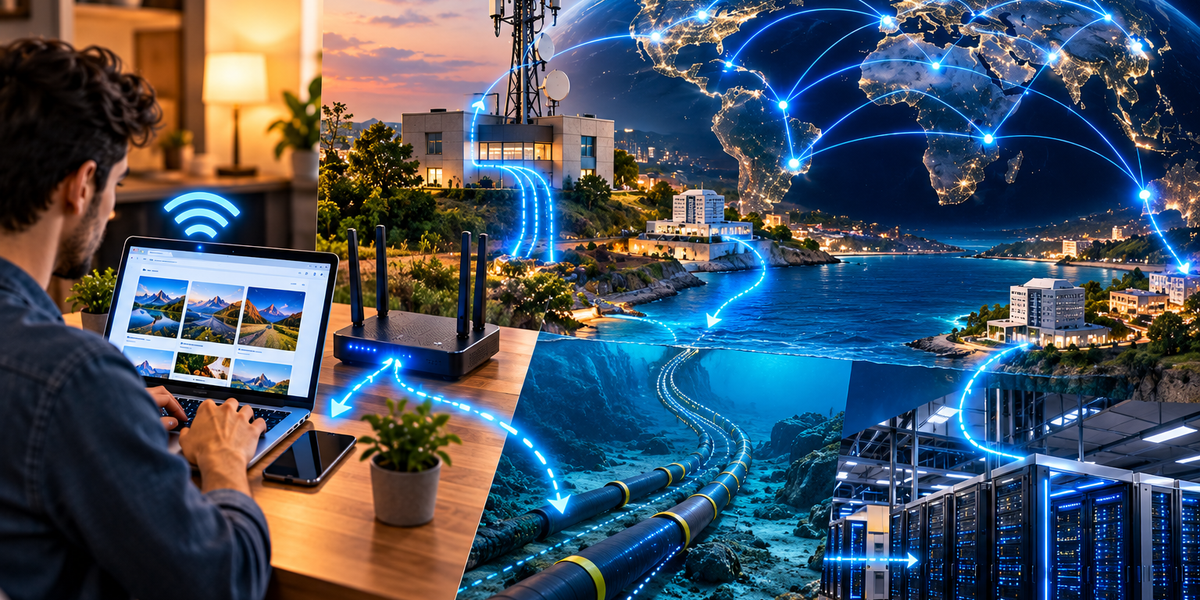
Your phone might connect through Wi-Fi to your router, while your router connects to your internet service provider through fiber, cable, or another technology. From there, your provider connects you to the wider internet.
This explains why you can sometimes have “full Wi-Fi” while having no internet access. Your phone may have an excellent wireless connection to your router, but the router itself may have lost its connection to your internet provider. The local network is working perfectly; the connection beyond it is not.
Mobile data works differently at the local level because your phone communicates with cellular infrastructure rather than your home router, but eventually that traffic also enters larger networks that connect to the internet.
The Internet Is Surprisingly Physical
The word “cloud” makes the internet sound weightless, but enormous amounts of internet traffic travel through physical infrastructure. Fiber-optic cables run beneath streets, alongside highways, through buildings, and across the ocean floor.
Submarine cables are especially important. Huge networks of fiber-optic cables stretch between continents and carry international internet traffic beneath the oceans. When you access information hosted on another continent, your data may literally travel through a cable resting on the seabed.
Fiber-optic cables transmit information using pulses of light, allowing enormous quantities of data to move extremely quickly. Satellites also provide internet connectivity and have become increasingly important in places where terrestrial infrastructure is difficult to build, but much of the world’s international internet traffic still relies on undersea cables.
So when someone says their information is “in the cloud,” that information is not floating in the atmosphere. It is ultimately being processed and stored on physical computers in physical facilities, connected by physical infrastructure.
What Exactly Is the Cloud?
Cloud computing is another term that sounds more mysterious than it really is. The cloud essentially means using computing resources located somewhere else rather than relying entirely on your own device.
If you save a photograph only on your laptop, the file exists on that machine’s storage. If you upload it to a cloud storage service, a copy is stored on servers operated by the service provider. When you later access that photograph from your phone, your phone connects to those servers through the internet and retrieves the information.
Large cloud providers operate enormous data centers containing thousands of servers. Companies can rent computing power, storage, databases, and other services instead of building all of that infrastructure themselves. Many websites and apps that appear completely independent may therefore be running on infrastructure owned by the same handful of large cloud providers.
The cloud is not a separate technology floating above the internet. It is largely a way of using remote computers through the internet.
How Streaming Works Without Downloading the Entire Movie First
Streaming demonstrates how efficiently modern internet systems can move data. When you watch a movie online, your device does not usually need to download the entire movie before playback begins. Instead, the service sends portions of the video as you watch.
Your device temporarily stores enough upcoming content to keep playback smooth. This process is called buffering. If your internet connection becomes slower than the rate at which the video needs new data, the buffer can run out and playback may pause.
Streaming platforms can also adjust video quality according to connection conditions. If bandwidth drops, the service may temporarily send a lower-quality version requiring less data. When the connection improves, the quality can increase again. This adaptive approach is one reason modern streaming can feel nearly instantaneous despite the enormous amount of information contained in high-resolution video.
Why Some Websites Load Faster Than Others
Distance matters on the internet because information cannot travel instantaneously. Even extremely fast signals need time to move through cables, routers, and other network infrastructure. The farther data has to travel and the more processing it encounters along the way, the greater the potential delay.
To solve this problem, websites often use content delivery networks, or CDNs. Instead of keeping every piece of content on one server in one country, a CDN can store copies of commonly requested material in many locations around the world.
If someone in Europe requests an image from a global website, the system may be able to deliver it from a nearby European server rather than retrieving it from a server thousands of miles away. Reducing the distance information has to travel can make websites significantly faster and more reliable.
Caching works on a similar principle. Frequently used information can be temporarily stored closer to the person requesting it, reducing the need to retrieve the same data repeatedly from its original source.
How Your Information Stays Private
Sending information across interconnected networks creates an obvious problem: sensitive information needs protection. This is where encryption becomes essential.
When you visit a modern website using HTTPS, communication between your browser and the website is encrypted. Encryption transforms information into a form that is extremely difficult for unauthorized parties to interpret without the necessary cryptographic keys.
This matters whenever you enter passwords, payment information, private messages, or personal details. Without encryption, information traveling through networks could be much easier to intercept and read.
Encryption does not automatically make a website trustworthy, however. A malicious website can also use HTTPS. Encryption primarily means that the connection between you and that website is protected from ordinary interception; it does not guarantee that the person or organization operating the site has good intentions.
Who Owns the Internet?
Nobody owns the entire internet.
Different organizations own different pieces of it. Telecommunications companies own cables and network infrastructure. Technology companies operate data centers and cloud platforms. Individuals and businesses own servers and websites. Internet service providers maintain networks that connect customers. Governments regulate parts of the infrastructure within their jurisdictions, while technical organizations coordinate standards and systems that allow the broader network to function.
The internet works because all these separate systems can communicate using common protocols. Those protocols are essentially agreed-upon rules describing how computers should format, send, receive, and interpret information.
Two of the most important are TCP and IP, which are so fundamental that people often refer to the internet’s core networking system as TCP/IP. Other protocols handle specific tasks. HTTP and HTTPS are used for web communication, for example, while other protocols support email, file transfers, real-time communication, and many other services.
The Internet and the Web Are Not the Same Thing
Another common misunderstanding is that the internet and the World Wide Web are identical. They are closely connected, but they describe different things.
The internet is the underlying global network infrastructure that allows computers to communicate. The World Wide Web is one service that operates on top of that infrastructure. Websites and web pages are part of the web, but the internet also carries email, online gaming traffic, video calls, messaging services, file transfers, and many other forms of communication.
An easy way to think about it is that the internet is the transportation system, while the web is one of the many things traveling across it.
What Happens When You Send a Message?
Consider something as ordinary as sending a message from your phone. You type a sentence and press Send. Your device converts that information into digital data and sends it through your local connection, perhaps Wi-Fi or a cellular network.
From there, the data travels through networking infrastructure toward servers operated by the messaging service. Those systems determine the intended recipient and deliver or make the message available to that person’s device. Depending on the service, encryption may ensure that the message content can only be read by the intended participants.
To you, the entire process looks like a small bubble appearing on a screen. Behind it is an extraordinary chain of computers, cables, wireless signals, routers, protocols, software, and data centers working together in milliseconds.
Why the Internet Rarely Completely Goes Down
Because the internet is decentralized, there is no single switch that can simply turn off the entire global network. Individual services can fail, internet providers can experience outages, cables can be damaged, data centers can lose power, and entire regions can lose connectivity, but the wider internet can continue operating.
This resilience was built into the basic architecture of interconnected networks. Traffic can often take alternative routes when one path becomes unavailable. Companies can operate servers in multiple locations, while large services can distribute their infrastructure across different regions and providers.
That does not make the internet indestructible. Major infrastructure failures, software errors, cyberattacks, natural disasters, or deliberate government restrictions can cause serious disruptions. But the distributed nature of the network makes a single worldwide failure extraordinarily difficult.
The Internet Is Complicated, but the Basic Idea Is Simple
Behind every click are layers of technology developed over decades, and engineers can spend entire careers specializing in individual parts of internet infrastructure. Yet the fundamental concept is surprisingly understandable.
Your device connects to a network. That network connects to other networks. When you request something, systems such as DNS help determine where it is located. Your request is broken into data that can travel through routers and physical infrastructure toward another computer. That computer responds, information travels back, and software on your device turns the arriving data into something meaningful.
The remarkable part is not that any individual piece exists. Computers, cables, addresses, and communication rules are understandable technologies on their own. What makes the internet extraordinary is that billions of devices can use those pieces together.
Every time you load a webpage, send a photograph, stream a song, or make a video call, information begins a journey through a vast physical network spread across cities, countries, oceans, and continents. Most of the time, that journey takes less time than it takes you to notice it happening. That is the real magic of the internet: not that it is mysterious, but that an incredibly complicated global system has become so reliable that we barely have to think about it at all.