How Speedrunning Actually Works (And Why People Do It)
Most video games are designed to make you slow down and explore. Developers create environments to investigate, characters to meet, stories to follow, enemies to fight, and secrets to discover. A game that took hundreds of people years to build might be designed to keep the average player entertained for 20, 50, or even 100 hours.
Then a speedrunner arrives and tries to finish it in 37 minutes.
At first, speedrunning can look like someone simply playing a game extremely quickly. Watch an elite run closely, however, and something much stranger is happening. The player may deliberately walk backward, jump into a wall, skip an important item, manipulate an enemy into behaving strangely, pause on an exact frame, or launch a character through a section of the map the developers never intended anyone to enter.
Speedrunning is not simply about having fast reflexes. At its highest levels, it combines memorization, mechanical skill, probability, experimentation, technical knowledge, competition, and an almost absurd level of patience.
For many runners, the objective is simple: get from the beginning of a game to a defined ending as quickly as the rules allow.
Everything between those two points becomes a problem to solve.
A Speedrun Is a Race Against Time
The fundamental idea behind speedrunning is straightforward.
Choose a game, establish a set of rules, start a timer, and attempt to reach the required ending as quickly as possible.
A player’s completion time can then be compared with previous attempts or with runs performed by other players.
But immediately, complications appear.
What counts as completing the game? Are glitches allowed? Can the player skip major sections? Do loading screens count toward the time? Can downloadable content be used? What difficulty must be selected? Are external modifications allowed?
Speedrunning communities solve these questions by creating categories.
Without categories, comparing times would often be meaningless.
Why Speedruns Have Different Categories
Imagine two people trying to complete the same adventure game.
One plays through every major section but uses movement tricks to save time. Another exploits a glitch that allows them to skip directly from the opening area to the final boss.
Both may technically finish the game, but they are performing fundamentally different challenges.
This is why speedrunning uses categories.
One of the most common is Any%, which generally means reaching the required ending as quickly as possible without necessarily completing everything in the game.
Another common category is 100%, where runners must complete a community-defined set of objectives, often including collectibles, upgrades, bosses, or other major content.
There may also be categories such as Glitchless, All Bosses, Low%, or categories built around particular endings and game modes.
The exact definitions depend on the individual game and its community.
Any% Does Not Mean “Anything Is Allowed”
The name Any% can be confusing.
It does not necessarily mean that literally anything is permitted.
The category generally means that the runner only needs to complete whatever minimum amount of the game is necessary to reach the accepted ending.
The community can still prohibit certain techniques, hardware, modifications, or exploits.
A particular glitch might be allowed while another is banned because it crashes the game, manipulates external files, or makes meaningful competition impossible.
The rules are therefore part of the challenge.
Speedrunning is not simply about breaking a game. It is about breaking it within an agreed framework.
Speedrunners Build Routes
Before attempting a competitive speedrun, a runner needs a route.
A route is the planned sequence of actions used to complete the game efficiently.
Suppose a normal player enters a dungeon, finds three keys, defeats several enemies, collects an upgrade, and eventually reaches the boss.
A speedrunner might discover that only one key is actually required. They might use a movement technique to bypass a locked door, ignore most enemies, collect one specific item because it saves time later, and approach the boss with an unusual strategy designed to finish the fight several seconds faster.
Multiply those decisions across an entire game and the result is a speedrunning route.
Top routes can become extraordinarily optimized.
Every movement, item, menu selection, fight, and loading transition may have been studied.
Routes Are Constantly Changing
A world-record route is rarely permanent.
Someone may discover a faster movement technique. Another player may find a new glitch. Someone analyzing the game’s code may realize that an apparently random event can be manipulated.
A route that seemed nearly perfect can suddenly become obsolete.
This is one of the most exciting aspects of speedrunning.
Games that have existed for decades can still produce new discoveries.
A community might spend years believing a particular section requires three minutes, only for someone to discover a trick that completes it in thirty seconds.
Suddenly, every serious runner needs to learn the new method.
The competition changes overnight.
Speedrunners Look at Games Differently
A normal player sees a door.
A speedrunner may see a collision box, loading trigger, animation, and possible opportunity to save four seconds.
This difference in perspective is fundamental.
Players normally interact with games according to the rules presented by developers. Walls are walls. Locked doors require keys. Bosses must be fought. Levels have beginnings and endings.
Speedrunners investigate whether those assumptions are actually enforced by the game’s code.
Can the wall be crossed at a particular angle? Can the door’s loading trigger activate from the wrong side? Can an animation move the character through another object? Can the boss be skipped entirely?
The visible game is only one layer.
Speedrunners are often interested in the machinery underneath it.
Glitches Can Become Essential Techniques
Many speedrunning categories allow glitches.
A glitch is unexpected behavior produced by the interaction of the game’s systems.
Some glitches are simple. A character might clip through a wall.
Others can be extraordinarily complicated, requiring specific items, precise positioning, carefully timed inputs, or manipulation of the game’s memory.
To an ordinary player, exploiting glitches might seem like cheating.
Within a speedrunning category where those techniques are explicitly allowed, however, they are simply part of the competition.
Every runner has access to the same knowledge.
The challenge becomes executing the glitch reliably under pressure.
What Is Sequence Breaking?
Games often expect events to happen in a particular order.
You defeat one boss to obtain an item. That item opens another area. Completing that area unlocks the next part of the story.
Speedrunners frequently attempt to break this sequence.
If they can reach an area earlier than intended, they may skip large sections of the game.
This is called sequence breaking.
Some sequence breaks rely on glitches. Others simply exploit clever movement or overlooked level design.
Interestingly, some developers now deliberately include opportunities for sequence breaking because they know players enjoy discovering unconventional routes.
An idea that once meant violating the intended structure of a game has gradually become part of game design itself.
Movement Is Often More Important Than Combat
Saving a few seconds in one boss fight can be valuable.
Saving a fraction of a second every time the character moves can be even more important.
Consider a game where the runner spends 40 minutes traveling through environments.
If a movement technique makes travel just 2% faster, the total savings across the run can become significant.
Speedrunners therefore study movement obsessively.
Perhaps jumping repeatedly is slightly faster than running. Maybe moving diagonally produces greater speed. Perhaps rolling cancels part of an animation. Maybe jumping on particular slopes preserves momentum.
These techniques can look bizarre to spectators.
There is usually a reason behind them.
Small Time Saves Become Enormous
Suppose a runner discovers a technique that saves only half a second.
That sounds almost meaningless.
But if the action occurs 50 times during the run, the technique can save 25 seconds overall.
At elite levels, that can be enormous.
This explains why speedrunners care about details that would be irrelevant to almost every other player.
Opening a menu one fewer time might matter. Choosing a different dialogue option might matter. Standing slightly closer to a door before pressing the interaction button might matter.
Once the obvious time savings have been discovered, records are improved through increasingly small optimizations.
Seconds eventually become tenths of seconds.
What Are Splits?
A long speedrun needs checkpoints that allow the runner to understand how the attempt is progressing.
These checkpoints are called splits.
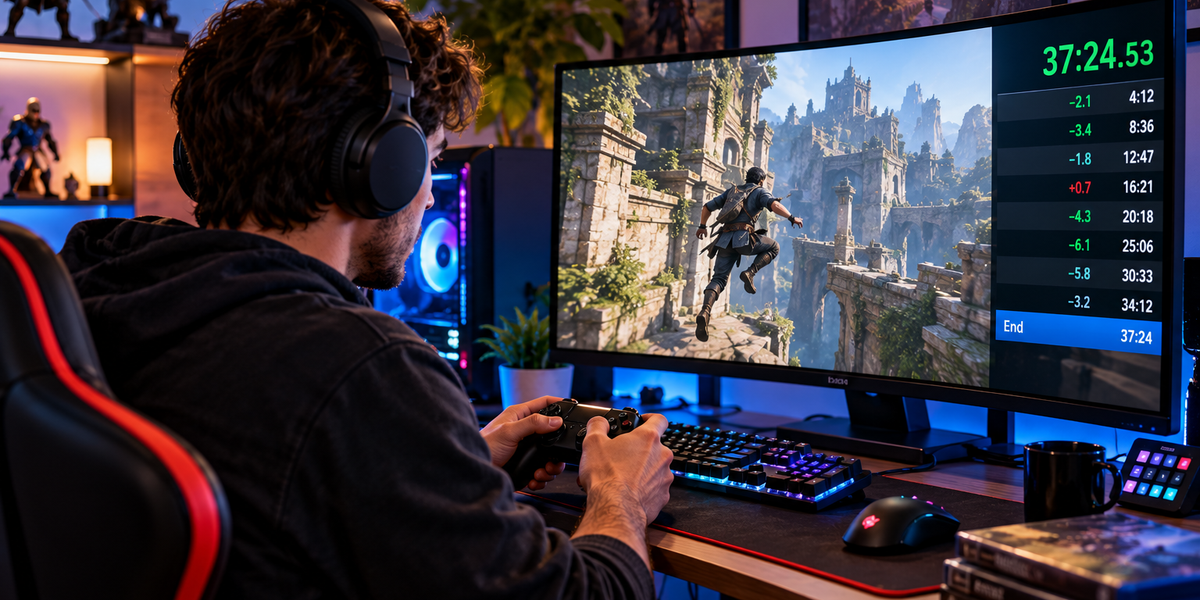
Imagine a runner completing a game containing eight major areas.
They might create a split after each area.
When they finish the first section, their timing software compares the current time with a previous run. Perhaps they are three seconds ahead.
After the second section, they may be eight seconds behind.
Splits allow the runner and viewers to see where time is being gained or lost.
They also make practice more useful because runners can identify specific sections that consistently cause problems.
What Does “PB” Mean?
PB means personal best.
It is the fastest time a particular runner has achieved.
For most speedrunners, the personal best is more relevant than the world record.
A beginner may be hours away from the best players in the world but can still experience meaningful competition by trying to beat their own previous time.
Perhaps the first completed run takes three hours.
The next takes two hours and forty minutes.
After weeks of practice, the runner reaches two hours.
That progression is one of speedrunning’s strongest attractions.
The game provides a measurable record of improvement.
What Is a World Record?
A world record, usually abbreviated WR, is the fastest verified run within a particular category under its established rules.
That last part matters.
There is not necessarily one world record for a game.
A game might have separate records for Any%, 100%, Glitchless, different difficulty levels, different characters, different platforms, and other categories.
Some communities even separate records based on game versions because patches can change loading times, physics, glitches, or other mechanics.
A world record therefore belongs to a very specific competitive context.
Timing a Speedrun Is More Complicated Than Starting a Stopwatch
Different games use different timing methods.
The simplest is real time, sometimes called real-time attack or RTA. The timer measures actual elapsed time from the defined starting point to the defined ending point.
But loading screens can create complications.
A player using faster storage might gain an advantage simply because the game loads more quickly.
Some communities therefore use timing methods that remove or account for loading time.
Others use in-game timers when those timers are sufficiently reliable.
The community establishes rules so that performances can be compared as fairly as possible.
Hardware Can Affect Speedruns
The machine running the game can influence performance.
Different consoles may have different loading speeds. Older hardware revisions can behave differently. PC frame rates can affect certain game mechanics. Regional releases may contain differences.
Even language settings can matter.
If one language displays dialogue with fewer characters or faster text, choosing that language might save time across hundreds of conversations.
This is why speedrunning rules can become incredibly specific.
What looks like excessive bureaucracy is usually the result of someone discovering that an apparently meaningless detail provides a competitive advantage.
Randomness Makes Some Runs Unpredictable
Not every element of a game behaves exactly the same way each time.
Enemies might choose different attacks. Items may appear randomly. Characters can move unpredictably. Critical hits may occur by chance.
Speedrunners often call this RNG, referring to random number generation.
RNG can dramatically affect a run.
A player may execute everything perfectly and still lose time because an enemy chooses an inconvenient behavior.
In some games, runners simply have to adapt.
In others, players discover ways to manipulate randomness.
They may perform specific actions that influence the game’s internal random number generator and increase the likelihood of receiving a favorable result.
At that point, something that appeared random becomes another system to understand.
Boss Fights Become Mathematical Problems
A casual player might approach a boss fight by reacting to attacks and trying to survive.
A speedrunner approaches it as an optimization problem.
How much health does the boss have? Which attack deals the most damage per second? Which animations can be interrupted? Can damage be applied during a transition? Where should the character stand to influence the boss’s next movement?
A runner may intentionally take damage because avoiding the attack would cost more time.
They may enter the fight with almost no health because collecting healing items earlier would have been slower.
The goal is not necessarily to play safely.
It is to finish quickly.
Speedrunning Requires Enormous Amounts of Practice
A polished world-record attempt can make difficult techniques look effortless.
They are not.
A runner may practice one movement trick hundreds or thousands of times.
They might repeatedly reload the same boss fight until a particular strategy becomes automatic.
Long games create an additional challenge because a runner must perform consistently for hours.
A mistake near the beginning is frustrating.
A mistake after four hours of near-perfect play can destroy a potentially historic run.
Speedrunning therefore requires not only technical skill but concentration and emotional control.
Why Runners Keep Resetting
Watch a speedrunner practicing for a record and you may notice something strange.
They repeatedly restart the game.
A mistake occurs five minutes into a two-hour run, and instead of continuing, they reset.
This happens because a serious record attempt may have very little room for error.
If the runner loses enough time early, they may calculate that beating their personal best is extremely unlikely.
Restarting allows another attempt immediately.
This behavior can look extreme, but it emerges naturally as records become more optimized.
The closer a runner gets to their theoretical best performance, the fewer mistakes a successful attempt can contain.
What Is “Theoretical Best”?
Timing software can track the runner’s best performance on each individual segment.
Imagine a five-part game.
Perhaps the runner’s fastest first segment happened during one attempt, while their fastest second segment happened during another.
If you combine the best segment times they have ever achieved, you get an estimate of what a near-perfect run might look like.
This is sometimes called the sum of best segments.
The runner may never have performed all of those segments perfectly in a single attempt.
That gap between the personal best and the theoretical best becomes a measure of how much time could potentially still be saved.
Human Speedruns Have Limits
Eventually, a speedrun can become so optimized that meaningful improvements are incredibly difficult.
A runner cannot react instantaneously. Human hands cannot execute infinitely precise inputs. Random events can interfere.
At this level, records may improve by fractions of a second.
A new world record might beat the previous one by 0.2 seconds.
That can represent months or years of accumulated knowledge and practice.
The smaller the remaining improvements become, the more fascinating the competition can become for people who understand the game.
Tool-Assisted Speedruns Explore Something Different
Tool-assisted speedruns, usually called TAS runs, are a separate category of speedrunning.
Instead of asking what a human can realistically perform in real time, TAS creators use tools such as emulators, frame-by-frame input, save states, and other techniques to investigate what is theoretically possible within the game.
Inputs can be selected with extraordinary precision.
A TAS may execute sequences that would be effectively impossible for a human player.
These runs are not intended to compete directly with normal human speedruns.
They answer a different question.
Instead of “How fast can a person complete this game?” the question becomes “How fast can this game possibly be completed if inputs are nearly perfect?”
The results can reveal astonishing behavior hidden inside game code.
Sometimes Speedrunners Seem to Rewrite the Game
The most extreme speedrunning exploits can become difficult to distinguish from programming.
Certain old games allow players, through carefully controlled glitches, to manipulate memory.
By performing seemingly nonsensical actions in a precise sequence, runners may cause the game to interpret data in unexpected ways.
In extreme cases, players have manipulated game memory sufficiently to trigger behavior never intentionally programmed as normal gameplay.
These techniques are often associated with concepts such as arbitrary code execution.
At this point, speedrunning becomes less like traditional gaming and more like applied computer science.
The player is no longer merely navigating the game world.
They are interacting with the underlying machine.
Communities Discover Most Techniques Together
Speedrunning may appear to be an individual competition, but much of the knowledge behind it is collaborative.
Players share discoveries.
Someone finds a glitch. Another person investigates why it works. Someone else develops a more reliable setup. Another runner discovers where the technique saves the most time.
Eventually, the knowledge becomes part of the standard route.
Competitors may spend months trying to beat one another’s records while simultaneously helping one another improve.
This unusual combination of competition and collaboration is central to speedrunning culture.
Everyone wants to be fast, but many also want to know how fast the game itself can ultimately become.
Speedruns Need Verification
Because records matter, competitive communities need ways to verify them.
Runners generally provide video evidence showing the entire attempt.
Moderators can review the footage to confirm that the correct game version, category rules, timing method, and permitted techniques were used.
Suspicious runs may receive additional scrutiny.
Cheating can involve edited footage, manipulated timers, unauthorized modifications, spliced attempts, or other methods.
Communities therefore develop verification standards based on the game and the seriousness of its leaderboard.
Trust matters, but evidence matters too.
Speedrunning Can Bring Old Games Back to Life
One of the most interesting things about speedrunning is how it changes the lifespan of games.
A game released decades ago may still have an active competitive community.
Players continue searching for new routes, studying old code, improving records, and developing increasingly sophisticated techniques.
Sometimes a new discovery suddenly transforms a game everyone thought had been fully understood.
An obscure title can even become famous primarily because its speedrun is entertaining.
Speedrunning treats games not as disposable releases but as systems that can be studied indefinitely.
Speedrunning Events Turn It Into a Spectator Sport
Speedrunning is also surprisingly entertaining to watch.
Major events bring runners together to demonstrate games while commentators explain techniques, glitches, and strategies.
The audience gets to see someone perform a game at an extremely high level while simultaneously learning how the game works underneath the surface.
Charity marathons have helped introduce speedrunning to much larger audiences.
A run can be funny, tense, educational, or astonishing depending on the game.
Unlike traditional esports, the opponent is often not another player standing on the stage.
The opponent is the clock.
Why Would Anyone Do This?
This is the question people outside speedrunning often ask.
Why play the same game hundreds of times? Why spend weeks practicing a trick that saves three seconds? Why restart after one small mistake?
For some people, the answer is competition.
They want the world record.
For others, it is self-improvement. Reducing a personal best from one hour to fifty-five minutes can feel enormously satisfying even if the world record is forty minutes.
Some enjoy discovering glitches. Others enjoy the community. Some love a particular game enough that learning every detail becomes enjoyable in itself.
And some simply find optimization addictive.
There is always another second somewhere.
Speedrunning Turns Games Into Puzzles
Perhaps the best way to understand speedrunning is to stop thinking of it as playing a game quickly.
A speedrunner treats the entire game as a puzzle.
Every room asks whether there is a faster path. Every animation raises the question of whether it can be skipped. Every enemy becomes a potential obstacle or tool. Every menu contains possible time savings. Every rule of the game becomes something worth testing.
Eventually, runners understand games in ways ordinary players never need to.
They know where invisible triggers sit, how the engine handles movement, which animations have vulnerable frames, how randomness is generated, and exactly how many seconds each decision costs.
The developers built a game.
Speedrunners discover another game hidden inside it.
The first game asks whether you can reach the end.
The second asks how little time you actually need to get there.