
How Black Holes Actually Work (Explained Simply)
Black holes sound like objects invented specifically to make physics confusing. They are places where gravity becomes so extreme that nothing crossing a certain boundary can return, where time behaves differently depending on who is observing, and where our best theories eventually reach conditions they cannot fully describe. Some black holes contain millions or billions of times the mass of the Sun, yet the most important part of a black hole is not a physical surface you could point to. It is a boundary in spacetime.
Despite their reputation, however, the basic idea behind a black hole is understandable.
A black hole forms when enough mass becomes concentrated into a sufficiently small region. The resulting gravity becomes so strong that beyond a boundary called the event horizon, every possible path through spacetime leads farther inward. Escaping would require something physically impossible: moving outward faster than light.
Black holes therefore are not holes in the ordinary sense, and they are not cosmic vacuum cleaners wandering around swallowing everything nearby. They are extreme gravitational objects governed by the same physics that shapes planets, stars, and galaxies, pushed into conditions unlike anything we experience on Earth.
Start With Gravity
To understand black holes, start with something familiar.
Earth has gravity because it has mass. The Sun has much stronger gravity because it contains vastly more mass. Gravity keeps Earth orbiting the Sun and the Moon orbiting Earth.
In Newton’s description, masses attract one another.
Einstein’s general theory of relativity provides a deeper picture. Mass and energy affect the geometry of spacetime, and objects move through that curved spacetime.
This sounds abstract, but the basic idea is surprisingly intuitive.
The presence of matter changes the environment through which other matter moves.
A black hole is what happens when that curvature becomes extraordinarily extreme.
Spacetime Combines Space and Time
We normally talk about space and time as separate things.
There is where something happens and when it happens.
Relativity showed that they are deeply connected.
Together, physicists describe them as spacetime.
Massive objects distort spacetime, and this affects how objects move and how time passes.
Earth does this slightly.
The Sun does it more strongly.
A black hole does it dramatically.
This is why black holes are not simply about “strong gravity.”
They are about extreme geometry.
A Star Is a Battle Between Gravity and Pressure
Many black holes begin with stars.
A star contains an enormous amount of mass, so gravity constantly tries to pull its material inward.
Why does the star not immediately collapse?
Because processes inside the star produce outward pressure.
During most of a star’s life, nuclear fusion releases energy while internal pressure helps resist gravitational collapse.
The star exists in a long-running balance.
Gravity pulls inward.
Pressure pushes outward.
For the Sun, this balance has lasted billions of years.
But stars eventually change.
Massive Stars Can Eventually Lose the Fight
A star cannot perform the same nuclear fusion forever.
Its available fuel and internal structure evolve.
For sufficiently massive stars, the final stages can become catastrophic.
Once the star can no longer generate enough pressure to support its core against gravity, the core can collapse.
What happens next depends heavily on the star’s mass and other properties.
Some stellar remnants become white dwarfs.
Others become neutron stars.
But if a collapsing core is sufficiently massive, no known pressure can stop the collapse.
A black hole can form.
Black Holes Are Not Made of “Black Stuff”
The name can be misleading.
A black hole is not a ball made from a mysterious black substance.
The defining feature is the structure of spacetime created by an extremely compact concentration of mass-energy.
The region becomes “black” because light that crosses the event horizon cannot escape to distant observers.
Since ordinary vision depends on light reaching our eyes or telescopes, the black hole itself appears dark.
We generally detect black holes through what they do to their surroundings.
The Event Horizon Is the Point of No Return
The most famous feature of a black hole is the event horizon.
This is a boundary surrounding the black hole.
Once something crosses it, returning to the outside universe becomes impossible according to classical general relativity.
The event horizon is not necessarily a solid surface.
You would not crash into a wall at the horizon.
For a sufficiently large black hole, crossing the event horizon might not produce any locally dramatic sensation at that exact moment.
The significance of the boundary is causal.
Once inside, no signal you send can reach the outside.
Why Can’t Light Escape?
You may have heard that black holes have gravity so strong that even light cannot escape.
That is correct, but the explanation needs care.
Light always moves locally at the speed of light in vacuum.
The black hole does not simply grab photons and force them to move more slowly until they stop.
Instead, spacetime inside the event horizon is curved in such an extreme way that all future-directed paths lead farther inward.
Even light moving as fast as physically possible cannot find an outward path that reaches the external universe.
The problem is not that light is too slow.
The geometry gives it nowhere outward to go.
Escape Velocity Gives a Useful Approximation
There is a simpler Newtonian way to build intuition.
Escape velocity is the speed needed to escape an object’s gravitational influence without additional propulsion.
Earth’s escape velocity is about 11.2 kilometers per second.
More massive and compact objects have higher escape velocities.
Imagine compressing an object while keeping its mass the same.
As it becomes smaller, the gravitational field near its surface becomes stronger, and the escape velocity increases.
Eventually, the simple analogy reaches a point where the escape velocity would equal the speed of light.
That gives a useful intuitive connection to the size associated with a black hole’s event horizon.
General relativity provides the actual description, but the escape-velocity picture is a helpful starting point.
The Schwarzschild Radius Tells Us How Small Is Small Enough
For a nonrotating, uncharged black hole, the radius of the event horizon is called the Schwarzschild radius.
The larger the mass, the larger this radius becomes.
If you could somehow compress the Sun enough, it would need to fit inside a sphere only a few kilometers in radius to become a black hole.
Earth would need to be compressed to something roughly the size of a small marble.
That does not mean ordinary planets are close to becoming black holes.
Compressing matter to those extremes would require extraordinary conditions.
The point is that black-hole formation depends on both mass and compactness.
A Black Hole Can Have the Same Gravity From Far Away
This leads to one of the most important black-hole facts.
If the Sun were magically replaced by a black hole with exactly the same mass, Earth would not suddenly be sucked into it.
Earth would continue orbiting approximately as before.
We would have much larger problems because sunlight would disappear, but the gravitational orbit itself would not suddenly collapse.
Why?
From far enough away, gravity depends primarily on the mass of the central object, not whether that mass is a star or a black hole.
Black holes become extraordinarily dangerous when you get close.
They do not possess infinite gravitational reach that automatically sucks in the universe.
Black Holes Are Not Cosmic Vacuum Cleaners
Popular culture often depicts black holes as giant drains moving through space and consuming everything nearby.
That image is misleading.
Objects can orbit black holes just as planets orbit stars.
Stars have been observed orbiting the supermassive black hole at the center of our own galaxy without immediately falling into it.
Material falls into a black hole when its trajectory carries it inward or when it loses enough orbital energy and angular momentum.
A black hole cannot simply reach across a galaxy and pull everything directly inside.
Gravity still follows rules.
Things Often Orbit Before Falling In
Matter approaching a black hole frequently possesses sideways motion.
Instead of dropping directly inward, it can orbit.
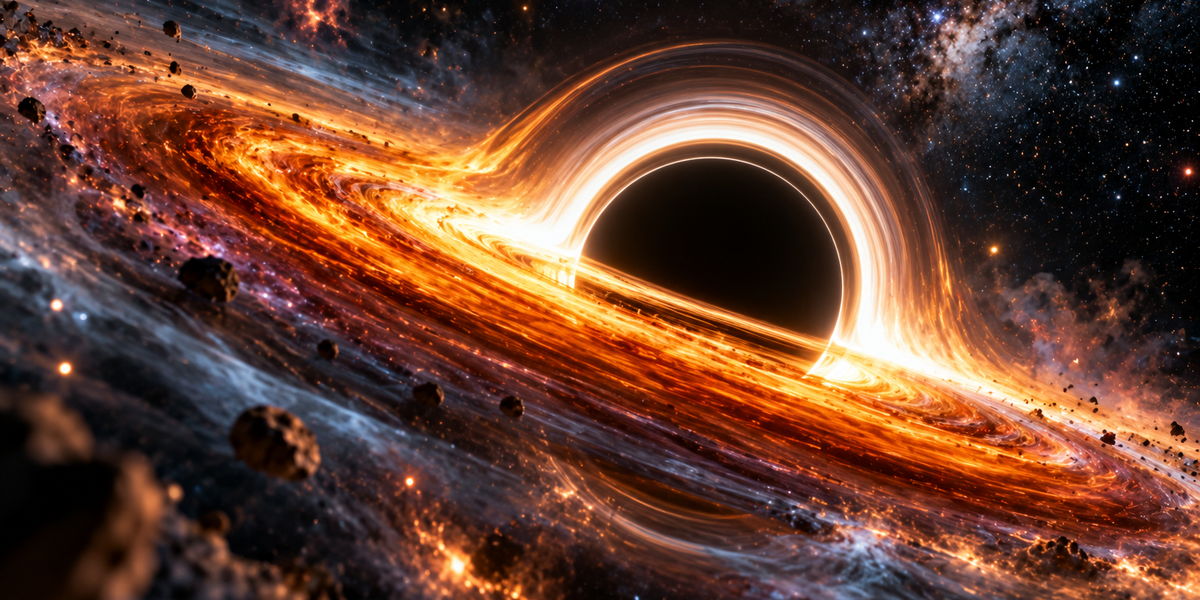
This material may form an accretion disk: a rotating structure of gas, dust, and other matter surrounding the black hole.
Material in the disk interacts.
Friction-like processes, turbulence, and magnetic effects redistribute energy and angular momentum.
Some matter gradually spirals inward.
As it does, gravitational energy is converted into heat.
The result can become astonishingly bright.
The Brightest Part Is Often Outside the Black Hole
This creates one of the great visual ironies of black holes.
The black hole itself emits no ordinary light from inside its event horizon.
But material surrounding an actively feeding black hole can become extraordinarily luminous.
Gas in an accretion disk can reach extreme temperatures and emit enormous amounts of electromagnetic radiation.
In some environments, especially around actively feeding supermassive black holes, the surrounding region can outshine entire galaxies.
So one of the darkest objects in the universe can power one of the brightest phenomena we observe.
Quasars Are Powered by Feeding Supermassive Black Holes
Some galaxies contain extremely active central regions known as active galactic nuclei.
Among the most luminous examples are quasars.
Their enormous energy output is associated with matter falling toward supermassive black holes.
The energy does not come from inside the event horizon.
It comes from matter outside it.
As material spirals inward, gravitational energy can be converted into radiation with remarkable efficiency.
This is why astronomers can detect active black holes across enormous cosmic distances.
The black hole is dark.
Its meal can be spectacular.
Black Holes Come in Different Sizes
Not every black hole is the same.
Stellar-mass black holes can form from the collapse of massive stars and typically contain masses comparable to multiple Suns.
Astronomers have also found evidence for black holes occupying intermediate mass ranges, although understanding their formation and population remains an active area of research.
Then there are supermassive black holes.
These contain millions or billions of solar masses and reside in the centers of many large galaxies.
Our own Milky Way has one.
It is called Sagittarius A*.
How Supermassive Black Holes Became So Large Is Still Studied
Supermassive black holes create an interesting cosmic puzzle.
Some existed surprisingly early in the history of the universe.
How did they become enormous so quickly?
Researchers investigate several possibilities.
Early black holes may have formed from the first generations of massive stars and then grown through mergers and accretion. Under certain conditions, much larger initial “seed” black holes may have formed through the direct collapse of enormous gas clouds.
Different pathways may have contributed.
The broad story is clear: black holes can grow by consuming matter and merging with other black holes.
The details of how the earliest giants formed remain an active research question.
What Is Actually at the Center?
General relativity predicts something extraordinary at the center of an idealized black hole.
A singularity.
In the simplest mathematical description, matter collapses toward a region where density and spacetime curvature become infinite.
But physicists generally do not interpret “infinity” here as proof that nature literally contains a point with ordinary physical quantities becoming infinitely large.
Instead, the singularity probably tells us that general relativity has reached the limits of its applicability.
We need a theory that successfully combines gravity with quantum physics to describe what actually happens under those conditions.
We do not yet possess a complete theory of quantum gravity.
“We Don’t Know” Is the Correct Answer About the Deepest Interior
Popular explanations sometimes confidently describe what exists at the center of a black hole.
Science cannot currently provide a complete answer.
General relativity describes black holes extraordinarily well on large scales.
Quantum mechanics describes the microscopic world extraordinarily well.
But extreme black-hole interiors require both.
Those two frameworks have not yet been fully unified.
Ideas such as string theory and loop quantum gravity attempt to address aspects of the problem, but there is no experimentally confirmed complete quantum theory of gravity.
The center of a black hole therefore represents one of the places where modern physics openly admits that something fundamental remains missing.
Time Really Does Behave Differently Near a Black Hole
One of the strangest predictions of relativity is gravitational time dilation.
Clocks deeper in a gravitational field run differently relative to clocks farther away.
This effect is not unique to black holes.
It happens around Earth too, although the differences are small.
Satellite navigation systems must account for relativistic effects because clocks in orbit do not behave exactly like clocks on Earth’s surface.
Near a black hole, however, gravitational time dilation can become extreme.
That creates some wonderfully strange situations.
What a Distant Observer Sees
Imagine watching someone fall toward a black hole from a safe distance.
As the person approaches the event horizon, signals reaching you become increasingly delayed and redshifted.
From your distant perspective, the person appears to slow as they approach the horizon.
Their light becomes progressively weaker and redder.
You do not simply watch them cross the event horizon in the ordinary way and disappear instantly.
Eventually, their signal becomes so faint and redshifted that they effectively vanish from view.
This is one of the reasons black-hole discussions become confusing.
Different observers describe the situation differently.
What the Falling Person Experiences
From the perspective of the falling person, the story is different.
Their own watch behaves normally.
Their heart beats normally.
They do not experience their personal time slowing down.
For a sufficiently large black hole, they can cross the event horizon after a finite amount of their own time without encountering a physical wall there.
Once across, however, escape becomes impossible.
Their future now leads inward.
This difference between what distant observers describe and what falling observers experience is not an illusion added by science fiction.
It follows from relativity.
You Would Not Necessarily Notice the Event Horizon
Suppose you fell into a supermassive black hole.
At the exact moment you crossed its event horizon, there might be no local sign saying, “You have now entered the black hole.”
No wall.
No sudden darkness switch.
No cosmic alarm.
Locally, the laws of physics would continue behaving normally.
The terrible part is that the boundary has changed what futures are available to you.
You can no longer send information to the external universe.
Turning around does not solve the problem.
Even a beam of light aimed outward cannot escape.
Small Black Holes Can Tear You Apart Earlier
Black holes create tidal forces because gravity changes with distance.
The side of your body closer to the black hole experiences stronger gravitational effects than the side farther away.
If that difference becomes extreme, your body is stretched in one direction and compressed in others.
This has acquired the wonderfully scientific-sounding nickname “spaghettification.”
Near smaller black holes, tidal forces can become lethal before or around the event horizon.
For very large supermassive black holes, the tidal difference at the horizon can actually be much gentler.
You could theoretically cross the horizon before tidal forces became catastrophic farther inside.
That is one of the stranger consequences of black-hole size.
Bigger Black Holes Can Be Gentler at the Horizon
This sounds backward.
Surely a larger black hole should always be more violent.
But the event horizon of a supermassive black hole is much larger.
At that horizon, the change in gravity across the length of a human body can be smaller than near the horizon of a stellar-mass black hole.
The overall gravitational situation remains extreme.
But what matters for stretching you apart is the difference in gravitational pull between nearby points.
Those tidal gradients can be weaker at the horizons of larger black holes.
So if you absolutely had to fall into a black hole, a supermassive one would offer a less immediately unpleasant horizon crossing.
This is not a recommended travel strategy.
Inside the Horizon, “Outward” Stops Working the Way You Expect
One of the hardest concepts about black holes is what happens to directions inside the event horizon.
Outside, you can choose to move toward or away from the black hole.
Inside, the geometry of spacetime changes the situation.
Moving toward the central region becomes as unavoidable, in a certain relativistic sense, as moving toward the future.
You cannot simply fire a sufficiently powerful rocket and head outward.
The problem is not insufficient engine power.
There is no future-directed path that takes you back across the horizon.
This is why the event horizon truly represents a point of no return.
Black Holes Can Spin
Real black holes are unlikely to be perfectly nonrotating.
Stars rotate.
Gas rotates.
When matter collapses, angular momentum is conserved.
The resulting black hole can therefore spin.
A rotating black hole is described differently from a simple nonrotating Schwarzschild black hole.
Its rotation affects the surrounding spacetime.
In a region outside the event horizon called the ergosphere, spacetime itself is dragged around by the black hole’s rotation.
This phenomenon is known as frame dragging.
The universe near a spinning black hole becomes even stranger.
Black Hololes Can Drag Spacetime Around With Them
Frame dragging is one of those predictions that sounds almost impossible to visualize.
A rotating mass can twist the geometry of spacetime around itself.
Earth does this by a tiny amount.
A rapidly spinning black hole can do it dramatically.
Inside the ergosphere, an object cannot remain stationary relative to a distant observer in the ordinary sense.
It is forced to participate in the rotation.
In principle, energy can even be extracted from a rotating black hole through processes that take advantage of this region.
Black holes are not simply passive gravitational pits.
They can store enormous rotational energy.
Black Holes Can Produce Enormous Jets
Some actively feeding black holes are associated with enormous jets of particles extending far beyond their host galaxies.
It is easy to imagine these jets shooting directly out of the black hole.
They do not.
Nothing is escaping from inside the event horizon.
Instead, the jets are produced by complex interactions involving matter, magnetic fields, rotation, and the environment outside the horizon.
The exact mechanisms are an active field of astrophysical research, but the crucial distinction is clear.
Black-hole jets do not violate the rule that nothing escapes once it has crossed the event horizon.
The material in the jets never crossed it.
Black Holes Can Collide
Black holes do not exist in isolation forever.
Two black holes can orbit one another.
As they do, they lose orbital energy through gravitational radiation.
Their orbit gradually shrinks.
Eventually, they merge.
For a long time, gravitational waves were a prediction of Einstein’s general relativity without direct detection.
That changed in 2015, when scientists detected gravitational waves from merging black holes.
The signal had traveled across the universe before producing an unimaginably tiny distortion detectable on Earth.
It opened an entirely new way of observing the cosmos.
Gravitational Waves Are Ripples in Spacetime
When massive objects accelerate in certain ways, they can produce disturbances in spacetime that propagate outward.
These are gravitational waves.
Black-hole mergers are particularly powerful sources.
As two black holes spiral together, their orbital speed increases.
The gravitational-wave signal rises in frequency and strength.
Then the horizons merge and the newly formed black hole settles into its final state.
Scientists can analyze the waveform to estimate properties such as the masses and spins of the black holes involved.
We are effectively listening to spacetime ring.
We Have Actually Imaged Black-Hole Shadows
For decades, black holes were detected primarily through their gravitational effects and the radiation produced by surrounding material.
Then astronomers achieved something extraordinary.
The Event Horizon Telescope collaboration produced images showing the shadow-like region associated with supermassive black holes, first in the galaxy M87 and later Sagittarius A* at the center of the Milky Way.
These are not photographs of a black surface in the ordinary sense.
They show radiation from hot material around the black hole, distorted by extreme gravity, surrounding a darker central region.
Gravity bends the paths of light itself.
The resulting image provides a remarkable visual test of our understanding of black-hole physics.
Gravity Can Bend Light Around a Black Hole
According to general relativity, light follows paths through curved spacetime.
A massive object can therefore bend light passing nearby.
This effect is called gravitational lensing.
Black holes produce extreme lensing.
Light from material behind the black hole can be bent around it and reach an observer.
Images can become distorted, magnified, or duplicated.
This is why realistic visualizations of black holes often show the accretion disk apparently bending above and below the black hole.
You are seeing light from parts of the disk whose paths were curved by gravity.
There Is Even a Region Where Light Can Orbit
Around a nonrotating black hole, there is a region associated with unstable circular photon orbits, commonly discussed in terms of the photon sphere.
Light can, under idealized conditions, follow circular paths around the black hole.
These orbits are unstable.
A tiny disturbance can send the light either outward or inward.
This contributes to the complicated appearance of black-hole shadows and gravitational lensing.
Near a black hole, even the path taken by light becomes radically different from our everyday intuition.
Hawking Discovered That Black Holes Are Not Completely Black
Classical general relativity suggests that nothing escapes from inside the event horizon.
Quantum physics adds a surprising complication.
In the 1970s, Stephen Hawking showed that quantum effects around black holes imply that they should emit thermal radiation.
This became known as Hawking radiation.
The detailed physics is more sophisticated than the popular picture of particle pairs appearing beside the horizon, although that analogy is often used as an introduction.
The important consequence is remarkable.
Black holes can lose energy.
Black Holes Can Eventually Evaporate
If a black hole emits Hawking radiation, it loses mass.
Given enough time, an isolated black hole could theoretically evaporate.
For astrophysical black holes, however, the timescales are absurdly enormous.
A stellar-mass black hole would take vastly longer than the current age of the universe to evaporate under ordinary assumptions.
Supermassive black holes would take even longer.
So black-hole evaporation is not something astronomers expect to watch happen to ordinary astrophysical black holes anytime remotely soon.
But theoretically, black holes may not be eternal.
Smaller Black Holes Would Evaporate Faster
Hawking radiation has another counterintuitive property.
Smaller black holes are hotter and would radiate more strongly than larger ones.
As a black hole loses mass, its temperature increases.
Evaporation therefore accelerates.
This leads to fascinating theoretical questions about what happens during the final stages.
Without a complete theory of quantum gravity, however, physics cannot confidently describe the ultimate endpoint.
Once again, black holes lead us directly to the boundary between what our theories explain and what remains unknown.
Black Holes Create an Information Problem
Black holes produce one of the deepest puzzles in theoretical physics.
Quantum mechanics strongly suggests that information about a physical system should not simply be destroyed.
But if matter falls into a black hole and the black hole eventually evaporates as apparently thermal radiation, what happens to the information describing what fell in?
This is known as the black-hole information paradox.
Physicists have spent decades investigating possible solutions.
Ideas involving quantum information, holography, the nature of spacetime, and the structure of horizons have emerged from attempts to solve it.
The question sounds specialized.
Its implications may reach into the foundations of reality.
Could a Black Hole Be a Wormhole?
Science fiction loves connecting black holes with wormholes.
General relativity does contain mathematical solutions involving structures sometimes described as wormholes or Einstein-Rosen bridges.
That does not mean an ordinary astrophysical black hole provides a usable tunnel to another location.
There is no evidence that falling into a black hole would transport you safely elsewhere.
Known theoretical wormhole scenarios face enormous problems involving stability and exotic physical conditions.
Black holes are real astronomical objects.
Traversable cosmic shortcuts remain speculative.
It is important not to confuse the two simply because both appear in relativity.
Could Black Holes Lead to Other Universes?
Some speculative models have explored whether black-hole interiors might connect with other regions of spacetime or even play roles in creating new universes.
These ideas are fascinating.
They are not established facts.
The problem is that we cannot receive information from beyond an event horizon once something has crossed it.
That makes direct experimental investigation extraordinarily difficult.
The interior also enters regimes where quantum gravity may become essential.
So when someone confidently claims to know that every black hole contains another universe, the science has traveled much farther than the evidence.
The scientifically responsible answer remains: we do not know.
What Would Happen if Earth Fell Into a Black Hole?
If Earth somehow approached a black hole, the outcome would depend on the black hole’s mass, Earth’s trajectory, and the surrounding environment.
Earth would not simply disappear the moment the black hole became nearby.
It could initially orbit.
If the orbit decayed or the planet approached too closely, tidal forces would eventually become devastating.
Earth could be stretched and disrupted, with its material potentially forming part of an accretion flow before some of it crossed the event horizon.
The exact sequence would vary.
Either way, it would be a very bad day.
There Is a Black Hole in the Center of Our Galaxy
The Milky Way contains a supermassive black hole called Sagittarius A* at its center.
It has a mass of roughly four million Suns.
That sounds terrifying until you remember that the galactic center is around 26,000 light-years from Earth.
Sagittarius A* is not gradually sucking the Milky Way into oblivion.
Stars orbit the galactic center under the combined gravitational influence of the mass distributed throughout the region, with the central black hole dominating very close to itself.
Astronomers have tracked stars moving around Sagittarius A*, providing powerful evidence for the enormous compact mass located there.
Most Large Galaxies Appear to Have Central Supermassive Black Holes
Supermassive black holes are not rare oddities.
Astronomers have found evidence that many large galaxies contain them at their centers.
Even more interestingly, properties of central black holes correlate with properties of their host galaxies.
This suggests that the evolution of galaxies and their central black holes may be connected.
Black holes can influence surrounding gas through radiation, jets, and energetic outflows.
Those processes can affect star formation and galactic evolution.
The object famous for swallowing matter can therefore influence how entire galaxies develop.
Black Holes Do Not Live Forever, but They Live Almost Forever
Stars eventually stop shining.
Galaxies evolve.
The universe itself changes.
Black holes may persist for unimaginably long periods.
If our current understanding of Hawking radiation is correct, they can eventually evaporate, but the timescales for large black holes dwarf the present age of the universe.
In some extremely distant future scenarios, black holes could be among the last major astrophysical objects remaining.
They are born from the deaths and growth of cosmic structures and may outlive almost everything that created them.
Black Holes Are Laboratories for Extreme Physics
Scientists care about black holes for reasons far beyond their dramatic appearance.
They allow us to test general relativity under extreme conditions.
Their mergers produce gravitational waves.
Their surroundings reveal how matter behaves under intense gravity and magnetic fields.
Their thermodynamics connects gravity with quantum physics.
Their information paradox challenges our understanding of fundamental physical laws.
Their interiors expose the limits of current theories.
Few objects force so many branches of physics into the same conversation.
They Are Also Simpler Than You Might Expect
Strangely, a black hole can be described externally using relatively few properties.
In classical general relativity, an isolated black hole can essentially be characterized by its mass, electric charge, and angular momentum.
The original object may have been extraordinarily complicated.
Perhaps it formed from a star containing countless particles and complex internal structures.
After collapse, most of those details are no longer visible to the outside universe in the ordinary sense.
The black hole becomes astonishingly simple externally while hiding some of the deepest mysteries in physics internally.
The Event Horizon Is What Makes a Black Hole a Black Hole
It is easy to focus on the singularity because it sounds dramatic.
But observationally and conceptually, the event horizon is arguably the defining feature.
It separates events capable of influencing the outside universe from events that cannot.
Once something crosses that boundary, no ordinary signal from it can return.
The horizon therefore represents more than a location.
It is a boundary in cause and effect.
That is why black holes force physicists to think not merely about objects moving through space but about the structure of spacetime itself.
Black Holes Are Not Holes in Space
Perhaps the most useful misconception to eliminate is the image created by the name.
A black hole is not literally a puncture in a flat cosmic sheet with matter falling through to somewhere underneath.
The common rubber-sheet demonstration of gravity can help visualize curvature, but it is only an analogy.
Space has three dimensions, and spacetime includes time.
A black hole is a region where spacetime geometry has become so extreme that an event horizon forms.
There is no ordinary “bottom” underneath space.
The geometry itself is the phenomenon.
The Simplest Way to Think About a Black Hole
Forget the cosmic vacuum cleaner.
Forget the giant hole swallowing the universe.
Imagine instead that matter changes the geometry of spacetime.
Ordinary objects change it slightly.
Stars change it more.
Compress enough mass into a sufficiently small region, and the distortion becomes so extreme that a boundary appears beyond which every future path points inward.
That boundary is the event horizon.
Outside it, you can still escape.
Cross it, and you cannot.
Matter can orbit outside. Gas can become extraordinarily hot. Light can bend around the black hole. Time can pass differently relative to distant observers. Black holes can spin, collide, merge, and slowly lose energy through quantum effects.
But the basic idea remains remarkably compact.
A black hole is what happens when gravity stops being merely a force pulling things toward an object and becomes an inescapable feature of the geometry of spacetime itself.
And somewhere beyond that event horizon, our current understanding of physics eventually reaches a place where the most scientifically accurate explanation is also the most intriguing one:
We do not yet know what happens next.